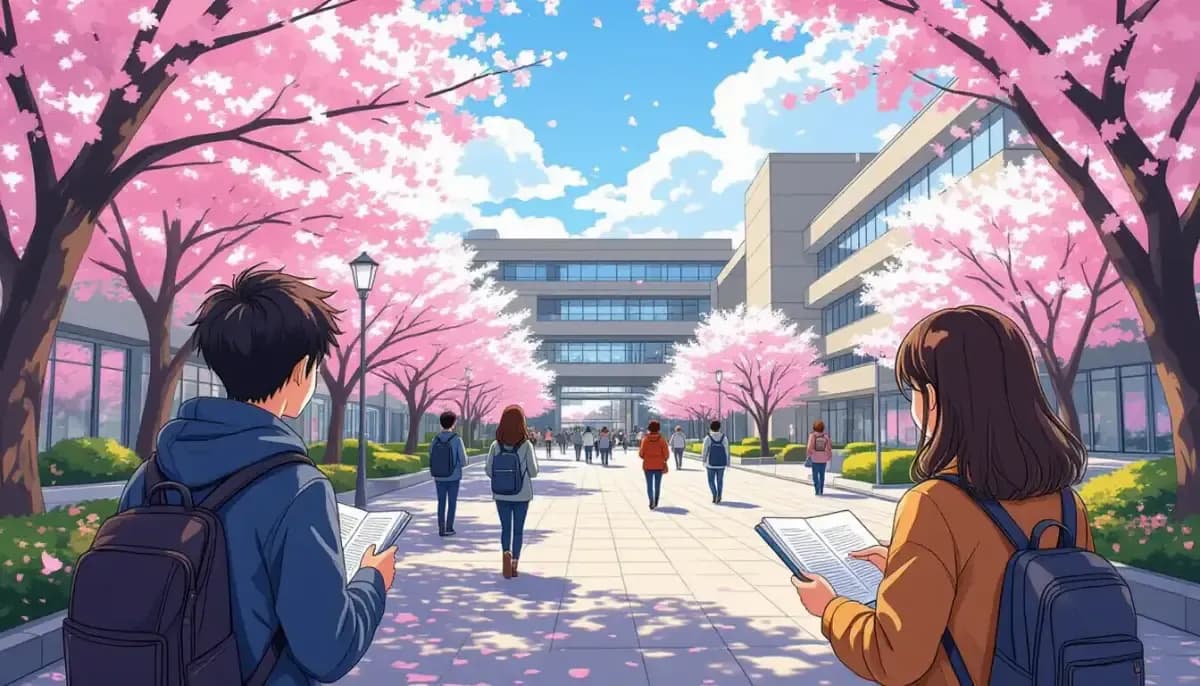
The Complete Guide to Studying in Japan as a Foreign Student
Japan has emerged as one of the world's most exciting study abroad destinations. With world-class universities, a unique cultural experience, and growing opportunities for international students, it is no surprise that Japan now hosts over 435,200 international students as of June 2025 — surpassing the government's 2033 enrollment target eight years ahead of schedule. Whether you are drawn by Japan's academic excellence, its vibrant culture, or the career opportunities that follow graduation, this comprehensive guide covers everything you need to know to make studying in Japan a reality.
!Foreign students studying at a Japanese university campus with cherry blossoms
Why Study in Japan? Key Benefits for Foreign Students
Japan consistently ranks among the top destinations for international education, and for good reason. Here are the most compelling reasons to consider Japan for your studies:
Academic Excellence: Japan is home to some of Asia's best universities, including the University of Tokyo, Kyoto University, and Osaka University — all ranked in the world's top 100 institutions. Japan invests heavily in research across sciences, engineering, and technology.
Safety and Quality of Life: Japan is consistently ranked as one of the world's safest countries. Students enjoy clean cities, efficient public transportation, excellent healthcare, and a uniquely high standard of living even on a student budget.
Cultural Immersion: Studying in Japan means living the culture, not just observing it. From traditional arts like tea ceremony and kabuki, to cutting-edge pop culture and technology, Japan offers an unparalleled cultural education alongside your academic studies.
Career Opportunities: The Japanese job market is actively recruiting international graduates. The 2023 offer rate for international students seeking employment in Japan reached 52.5%, and over 866,000 highly skilled foreign professionals now work in the country.
Language Skills: Even basic Japanese language skills are highly valued by global employers. Studying in Japan gives you daily language immersion that accelerates fluency far faster than classroom study alone.
For a broader overview of life in Japan as a foreigner, see our Complete Guide to Daily Life in Japan for Foreigners.
Types of Study Programs in Japan
Understanding your options is the first step to planning your Japanese education. Japan offers six main types of study programs for international students:
| Program Type | Duration | Best For | Japanese Required? |
|---|
| Japanese Language School | 6 months – 2 years | Beginners, visa pathway | No (taught in Japanese) |
| Vocational College (Senmon Gakko) | 2 – 3 years | Practical skills, IT, design | Intermediate |
| Undergraduate Degree | 4 years | Bachelor's degree seekers | Varies by program |
| Graduate Program | 2 – 5 years | Master's/PhD students | Varies by program |
| Exchange Program | 6 months – 1 year | Current university students | Low to intermediate |
| Short-term Programs | A few weeks – 3 months | Language immersion, exploration | None |
Japanese Language Schools are the most common entry point for international students. They provide intensive Japanese instruction while helping students adjust to life in Japan, and many students use them as a stepping stone to university admission.
Vocational Colleges (Senmon Gakko) offer practical, career-focused training in fields like IT, design, culinary arts, fashion, and healthcare. They are popular among students who want hands-on skills rather than academic degrees.
Undergraduate and Graduate Programs range from fully Japanese-taught to entirely English-taught, with an increasing number of universities offering English-medium programs to attract international talent.
For students interested in learning the language first, our Complete Guide to Learning Japanese as a Foreigner is an excellent companion resource.
How to Apply: The Japan Student Visa Process
Obtaining a student visa is the most critical step in your journey to study in Japan. The process typically follows these stages:
Step 1: Receive Admission Apply to and receive acceptance from your chosen school. Your school will handle much of the subsequent paperwork on your behalf.
Step 2: Certificate of Eligibility (COE) Your school applies to the Japanese Immigration Services Agency for a Certificate of Eligibility on your behalf. This document certifies that you meet the requirements for a student visa. Processing typically takes 1-3 months.
Step 3: Apply for Your Visa With your COE in hand, visit the Japanese embassy or consulate in your home country to apply for your student visa. Single-entry student visas cost approximately $20 USD (¥3,000) and multiple-entry visas cost $40 USD (¥6,000).
Step 4: Arrive in Japan Upon arrival, you will receive your Residence Card (Zairyu Card) at the airport. This card serves as your official ID throughout your stay in Japan.
Step 5: Register at Your Municipality Within 14 days of moving into your residence, register your address at the local city or ward office. This is legally required and opens access to healthcare and other services.
Student visas are typically valid for 1.3 to 2.3 years and are renewable as long as you remain enrolled in your program. For detailed visa information, see our Complete Guide to Japan Visa and Immigration.
For additional guidance on navigating the student visa process, Living in Nihon's comprehensive study guide provides in-depth advice on the entire journey from application to daily student life in Japan.
Costs of Studying in Japan: Tuition and Living Expenses
Japan is often perceived as expensive, but for many students it compares favorably with English-speaking study destinations. Here is a realistic breakdown of what to expect:
Tuition Fees
| Institution Type | Annual Tuition (Approximate) |
|---|
| National University | ¥535,800 (~$3,500 USD) |
| Public University | ¥500,000–¥700,000 |
| Private University | ¥1,000,000–¥2,000,000 |
| Japanese Language School | ¥600,000–¥900,000 |
| Vocational College | ¥700,000–¥1,200,000 |
Living Expenses
Monthly living costs vary significantly by location:
- Tokyo: ¥100,000–¥150,000 per month (including rent, food, transportation)
- Regional Cities (Osaka, Nagoya, Kyoto): ¥80,000–¥120,000 per month
- Smaller Cities and Rural Areas: ¥70,000–¥100,000 per month
The biggest variable is rent. University dormitories are the most affordable option (¥15,000–¥30,000/month), followed by shared houses, then private apartments. For detailed guidance on finding accommodation, read our Complete Guide to Finding Housing in Japan.
For a full financial picture of life in Japan, our Complete Guide to Cost of Living in Japan provides detailed budgeting advice.
Scholarships for International Students in Japan
The good news: scholarships are available, though competitive. The not-so-good news: approximately 96% of international students in Japan are self-funded. However, if you qualify, scholarships can dramatically reduce or even eliminate your costs.
Major Scholarship Programs
MEXT Scholarship (Government Scholarship) The most prestigious scholarship for studying in Japan, administered by the Ministry of Education, Culture, Sports, Science and Technology. Benefits include:
- Full tuition waiver
- Monthly stipend of approximately ¥140,000–¥145,000
- Round-trip airfare
- Japanese language training
Application is highly competitive and typically requires excellent academic records plus a nomination from your home country.
JASSO Scholarship The Japan Student Services Organization offers scholarships to enrolled international students at Japanese universities and colleges. Grants range from ¥48,000 per month and are available to students already in Japan. See the official Study in Japan website for current program details.
University-Specific Scholarships Most major universities offer their own scholarship programs ranging from partial tuition reduction (30–50%) to full scholarships. Research your target schools' financial aid pages thoroughly, as these are often underutilized by applicants.
Private Foundation Scholarships Numerous Japanese private organizations and foundations offer scholarships to international students in specific fields. These are often easier to obtain than government scholarships but require careful research.
The strategy many successful students use: stack multiple smaller scholarships to cover most of your expenses while using savings or part-time work income for the remainder.
Working While Studying in Japan
Most student visa holders are permitted to work part-time in Japan, which can help offset living costs significantly. The rules are clear and important to follow:
- During academic terms: Maximum 28 hours per week
- During extended school breaks (summer, winter): Maximum 8 hours per day (effectively full-time)
- Authorization required: You must apply for "Permission to Engage in Activity Other Than That Permitted Under the Status of Residence Previously Granted" at a regional immigration bureau — but in practice, your school handles this as part of your enrollment
Common part-time jobs for international students include convenience store staff (konbini), restaurant and café work, English tutoring, translation/interpretation, and customer service roles leveraging your language skills.
Part-time work income in Japan typically ranges from ¥1,000–¥1,500 per hour. Working the maximum 28 hours per week can generate approximately ¥100,000–¥130,000 per month, covering a significant portion of living expenses in most cities.
For students considering teaching English as a side income or career path, our Complete Guide to Teaching English in Japan provides detailed guidance.
!International students working on group project in Japanese classroom
University Admissions: How to Get Into a Japanese University
Getting accepted to a Japanese university requires preparation well in advance. Here are the key requirements and examinations:
For Japanese-Language Programs
EJU (Examination for Japanese University Admission for International Students) The standard standardized test for international students applying to Japanese universities. It covers:
- Japanese language proficiency
- Mathematics
- Science (physics, chemistry, biology)
- Japan and the World (comprehensive social sciences)
The EJU is held twice yearly (June and November) in Japan and at select overseas locations.
JLPT (Japanese Language Proficiency Test) Most Japanese-language university programs require N2 or N1 level Japanese proficiency. Language schools typically prepare students to reach the required level within 1-2 years.
For English-Language Programs
The number of English-taught degree programs has grown significantly as Japanese universities compete for global talent. These programs typically require:
- TOEFL iBT score of 80+ or IELTS 6.0+
- Academic transcripts
- Letters of recommendation
- Statement of purpose
Top universities offering English-taught programs include the University of Tokyo (UTokyo), Waseda University, Keio University, Ritsumeikan Asia Pacific University (APU), and Tohoku University.
Application Timeline
Most Japanese universities have two application periods: April intake (main intake, applications October–January) and October intake (applications April–July). April is the standard start of the academic year in Japan.
Student Life in Japan: What to Expect
Daily life as a student in Japan is rich, challenging, and deeply rewarding. Here's what you can expect:
Campus Life: Japanese universities have vibrant club and circle (circle = informal club) cultures. Joining clubs is one of the best ways to make Japanese friends and integrate into campus life. There are clubs for every interest imaginable, from traditional martial arts to anime, music, and sports.
Healthcare: As a registered resident of Japan, international students are enrolled in the National Health Insurance (NHI) system at significantly reduced premiums. Medical care is high quality and affordable with insurance coverage. See our Complete Guide to Healthcare in Japan for Foreigners for full details.
Banking and Finance: Setting up a Japanese bank account is essential for receiving scholarship payments and salary from part-time work. Our Complete Guide to Banking and Finance in Japan for Foreigners walks you through the process step by step.
Cultural Adjustment: Living in Japan as a foreigner involves a real learning curve around social norms, communication styles, and cultural expectations. Our Complete Guide to Japanese Culture and Etiquette for Foreigners will help you navigate these nuances.
Making Friends: Connecting with both Japanese students and the international student community is crucial for a fulfilling experience. For tips on building social connections, read our Complete Guide to Making Friends and Social Life in Japan.
From Student to Professional: Career Pathways After Graduation
One of the most compelling reasons to study in Japan is the potential to build a career there. Japan is actively working to attract and retain international talent in response to its aging population and labor shortages.
The For Work in Japan guide on transitioning from international student to professional provides excellent, detailed advice on the job-hunting process specific to international graduates.
Key points to know:
Job-Hunting Timeline (Shukatsu) Japan's structured recruitment system operates on a specific calendar:
- 3rd year, June: Begin internships
- 3rd year, March 1: Recruitment information released, applications open
- 4th year, June 1: Formal interviews begin
- 4th year, October 1: Offer ceremonies
Visa Transition Graduates must change their student visa to an appropriate work visa. The most common is the "Technology, Humanities, International Services" (技術・人文知識・国際業務) visa, which covers IT, engineering, translation, marketing, and many other fields.
Top Industries Hiring International Graduates
- IT and software development
- Trading and import/export
- Manufacturing
- Financial services and consulting
- Education and language services
If you do not secure employment by graduation, Japan also allows a one-year extension under "Special Activities" status to continue your job search.
For more on working in Japan, read our Complete Guide to Working in Japan as a Foreigner. If you are considering transitioning into Japan's IT sector after graduation, Ittenshoku is a valuable resource for IT career development and job hunting in Japan.
Practical Tips for a Successful Study Experience in Japan
Before you arrive, consider these practical recommendations from experienced international students:
- Learn basic Japanese before arrival — Even N5 level Japanese will dramatically improve your daily life experience and open more housing and part-time job options.
- Apply for scholarships early — Many scholarships require applications 1-2 years before you plan to study. Start researching as soon as you decide on Japan.
- Choose your location carefully — Tokyo offers the most opportunities but at higher cost. Cities like Osaka, Fukuoka, and Sendai offer excellent universities at significantly lower living costs.
- Use university housing your first year — University dormitories are the easiest and most affordable housing option when you first arrive. You can find private housing once you are settled.
- Build a support network immediately — Connect with your university's international student office, fellow students from your home country, and local language exchange partners from day one.
- Understand your tax obligations — As a resident of Japan, you will be subject to Japanese tax rules. Our Complete Guide to Taxes in Japan for Foreigners explains what you need to know.
- Plan for cultural adjustment — The excitement of arrival often gives way to culture shock at 3-6 months. This is completely normal. Building routines and community will help you through it.
For additional resources on building your life in Japan, the GoGoNihon study abroad guide offers practical insights from students who have made the journey.
Conclusion
Studying in Japan is a transformative experience that combines world-class education with an unparalleled cultural immersion. With over 435,000 international students already making Japan their academic home in 2025, the infrastructure, support systems, and opportunities for foreign students have never been better.
The key to success is thorough preparation: understanding your visa options, choosing the right program type for your goals, budgeting realistically, and taking full advantage of the academic, cultural, and career opportunities that Japan offers.
Japan is not just a place to earn a degree — it is a place that can shape the entire trajectory of your life. Start planning early, connect with the community of international students who have gone before you, and take the first step toward your Japanese education adventure.
For more information on the international student experience in Japan, visit the official Study in Japan website and the ICEF Monitor's analysis of Japan's record international student enrollment.