
Vocational and Technical Schools in Japan Guide

Complete guide to vocational schools (senmon gakko) in Japan for foreigners. Learn about admission requirements, costs, visa rules, fields of study, and career pathways after graduation.
Vocational and Technical Schools in Japan: The Complete Guide for Foreigners
Japan's vocational and technical schools — known as senmon gakko (専門学校) — offer one of the most practical and employment-focused educational pathways available to foreigners in Japan. With over 2,700 professional training colleges across the country and an increasing number of international students enrolling each year, these institutions have become an attractive alternative to traditional universities for those seeking hands-on, career-ready education.
Whether you're already living in Japan or planning to move there, this guide covers everything you need to know about vocational schools: what they are, how to get in, what to study, how much they cost, and how to transition into the workforce after graduation.
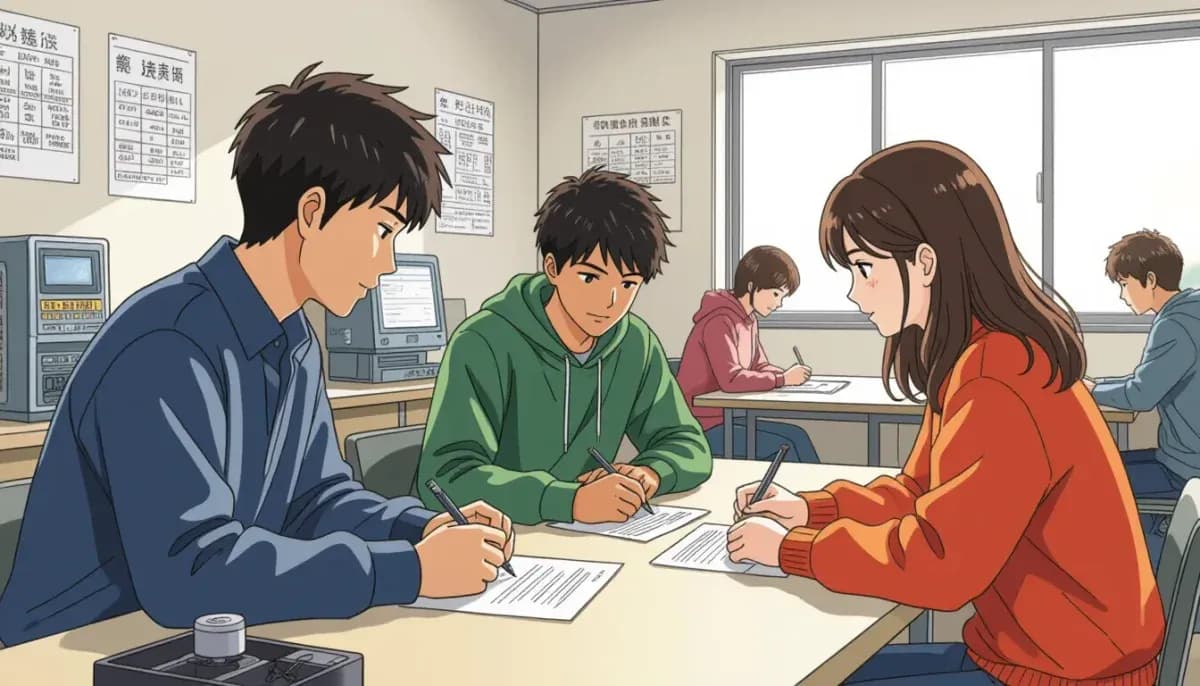
!Students in a Japanese vocational school engaged in hands-on technical training

What Are Vocational Schools in Japan (Senmon Gakko)?
Vocational schools in Japan, called senmon gakko (専門学校) or "professional training colleges," are higher education institutions that provide specialized, practical training directly tied to specific professions. Unlike universities, which emphasize academic theory and research, senmon gakko prioritize hands-on skills and industry-ready competencies.
These schools are officially recognized under Japanese law as post-secondary education institutions. Graduates receive government-recognized credentials — either a diploma (専門士) for 2-year programs or an advanced diploma (高度専門士) for 4-year programs.
Key Characteristics of Senmon Gakko
- Practical curriculum: Most class time is spent on real-world applications, studio work, labs, or simulated workplaces
- Short duration: Most programs are 2 years, shorter than the typical 4-year university
- Industry connections: Schools often partner with companies for internships and guaranteed job referrals
- Smaller class sizes: Compared to universities, classes are more intimate and instructor attention is greater
- Direct career pipeline: Graduation often leads directly to employment in the trained field
As of the early 2020s, Japan has over 2,700 such institutions serving hundreds of thousands of students annually — more than 90% of which are privately operated. In 2024 alone, 76,402 international students were enrolled in vocational programs across Japan, reflecting growing global interest in this educational track.
Eight Major Fields of Study
Japan's vocational schools are organized into eight major fields, encompassing dozens of sub-disciplines:
| Field | Example Career Paths |
|---|---|
| Industry | IT engineer, game developer, automobile mechanic, civil engineer |
| Agriculture | Agricultural technician, landscape designer, environmental manager |
| Medical Care | Nurse, dental hygienist, physical therapist, radiologist |
| Hygiene | Beautician, hair stylist, aesthetician, nutritionist |
| Education & Social Welfare | Childcare worker, social worker, special education assistant |
| Commercial Practice | Accountant, hotel manager, travel coordinator, flight attendant |
| Fashion & Home Economics | Fashion designer, interior designer, patternmaker |
| Culture & Liberal Arts | Photographer, musician, animator, manga artist, interpreter |
The most popular fields among international students in recent years include information technology, fashion and design, culinary arts, and anime/game production — areas where Japan has global recognition and strong industry demand.
Admission Requirements for Foreign Students
Getting into a Japanese vocational school requires meeting several criteria. Requirements vary by institution and program, but here are the general standards you can expect:
Academic Prerequisites
- Completion of at least 12 years of formal schooling in your home country (the equivalent of finishing secondary/high school)
- If your country's educational system has fewer than 12 years, you may need to complete 1–2 years of preparatory schooling in Japan before applying
- Minimum age of 18 years old
Japanese Language Requirements
This is the most important requirement for most programs, as classes are primarily conducted in Japanese. You must satisfy at least one of the following:
- Pass JLPT N2 (or N1) — the most common route
- Score 200+ points on the EJU (Examination for Japanese University Admission for International Students) Japanese section
- Complete at least 6 months of study at a government-accredited Japanese language school in Japan (some schools require 12 months)
- Have completed at least 1 year of education at a Japanese K-12 school
Some programs — especially in IT and design — are increasingly offering English-medium tracks, but these are still limited and typically more expensive.
Application Documents
- Completed application form
- Academic transcripts and certificates (with certified Japanese or English translations)
- Japanese language proficiency certificate (JLPT result or language school certificate)
- Letter of recommendation (from a teacher or previous employer)
- Personal statement explaining your motivation for the program
- Financial capability documents (proof you or a sponsor can cover tuition and living costs)
- Passport copy
For more on preparing for life in Japan as a foreign student, see our Complete Guide to Moving to Japan and the Japan Visa and Immigration Guide.
Tuition and Cost of Attending Vocational School
!Breakdown of tuition and living costs for vocational school students in Japan

Vocational schools are generally more affordable than universities in Japan, both in tuition and total study time. Here is a general breakdown of costs:
| Cost Category | Estimated Annual Cost (JPY) | Notes |
|---|---|---|
| Tuition | ¥800,000 – ¥1,500,000 | Varies widely by field and school |
| Enrollment/Admission Fee | ¥50,000 – ¥200,000 | One-time fee paid at enrollment |
| Living Expenses | ¥800,000 – ¥1,200,000 | Rent, food, transport, utilities |
| Textbooks & Materials | ¥50,000 – ¥200,000 | Higher in design/culinary programs |
| Health Insurance | ¥20,000 – ¥30,000 | National Health Insurance (NHI) |
| Total (1 Year) | ¥1,720,000 – ¥3,130,000 | Approximately $11,000 – $20,000 USD |
Medical and nursing programs tend to be on the higher end due to equipment and licensing requirements. IT and business programs are typically more affordable.
Scholarships and Financial Support
Several scholarship programs are available to international vocational school students:
- JASSO Scholarship (Japan Student Services Organization): Monthly stipends of ¥48,000 offered to qualifying international students
- School-based scholarships: Many senmon gakko offer merit-based tuition reductions or grants
- Regional government programs: Some prefectures (Tokyo, Osaka, Aichi) offer additional support for international students studying in high-demand fields
- Private foundation grants: Organizations like the Rotary Foundation and various Japan-based NGOs support international students
Student Visa and Work Permissions
To attend a vocational school in Japan as an international student, you will need a Student Visa (留学ビザ). Here's how it works:
- Apply for admission to a Japanese vocational school and receive an acceptance letter
- Apply for a Certificate of Eligibility (CoE) through the school's immigration support team
- Apply for your Student Visa at a Japanese embassy or consulate in your home country
- Enter Japan and register your address at the local municipal office
Once in Japan, you can apply for a "Permission to Engage in Activity Other Than That Permitted Under the Status of Residence" — commonly called a work permit — at your local immigration office. With this permit, student visa holders can work up to 28 hours per week during academic terms and up to 40 hours per week during school holidays.
This part-time work is a practical way to supplement your income and gain Japanese work experience while studying. Many students find jobs in convenience stores, restaurants, and retail, which also help with language immersion.
For more on navigating visa types and immigration processes, visit Living in Nihon's foreigner resources and our Japan Visa and Immigration Guide.
After Graduation: Career Pathways
One of the biggest advantages of attending a senmon gakko is the strong employment pipeline from school to career. Vocational schools maintain close relationships with employers and actively help graduates find jobs through:
- On-campus job fairs attended by hundreds of recruiting companies
- School recommendation letters (推薦状), which carry significant weight with Japanese employers
- Internship placements during the program that often convert to full-time offers
- Career center support for resume writing, interview prep, and job matching
Diploma Recognition and Academic Pathways
- 2-year program graduates (専門士) are eligible to transfer to university to earn a bachelor's degree (entering as a 3rd-year student)
- 4-year program graduates (高度専門士) hold a credential equivalent to a bachelor's degree and may apply directly to graduate school
Changing Visa Status After Graduation
Upon completing your program and securing a job offer, you can change your Student Visa to a work visa. Common visa categories for vocational school graduates include:
- Specified Skilled Worker (特定技能) — for jobs in designated labor-shortage industries
- Engineer/Specialist in Humanities/International Services (技術・人文知識・国際業務) — for IT, business, and professional roles
- Work Visa appropriate to your field (medical, education, etc.)
For tips on finding work in Japan as a foreigner, check out For Work in Japan and our Complete Guide to Working in Japan.
How to Find and Choose the Right Vocational School
With thousands of options, finding the right fit takes research. Here are the best resources:
- Association for Technical and Career Education — The official body for Japan's vocational education sector; searchable database of schools by field and prefecture
- Study in Japan Official Site — Government portal with vetted information on vocational programs
- Japan Living Guide - Vocational Schools — Practical breakdown of programs and requirements
Questions to Ask When Evaluating Schools
- What is the employment rate of graduates in my field?
- Does the school have partnerships with companies I'd like to work at?
- Is there Japanese language support for international students (tutoring, extra classes)?
- Are there English support services or materials available?
- What scholarships does the school offer to international students?
- Is the school located in a major city (Tokyo, Osaka, Nagoya) with strong job market access?
- What is the reputation of the program in the industry?
Tips for Succeeding as a Foreign Student in Japan's Vocational System
Attending a Japanese vocational school as a foreigner is a rewarding but demanding experience. Here are practical tips to help you succeed:
Before You Arrive
- Reach at least JLPT N3 before arriving, and aim for N2 before starting your program
- Research the local cost of living where your school is located — Tokyo and Osaka are significantly more expensive than smaller cities
- Line up housing early — school dormitories fill fast, and finding private accommodation takes time
- Connect with alumni or current students from your nationality online to get insider tips
During Your Studies
- Take advantage of the school's career center from day one, not just in your final year
- Participate in school events, clubs, and study groups — Japanese employers value cultural integration
- Practice Japanese daily outside the classroom through part-time work and social activities
- Keep your visa status current and notify the school immediately of any address changes
Building Your Career
- Use Japanese job-hunting platforms like Mynavi, Recruit, and indeed.co.jp alongside school placement resources
- Network with classmates — your cohort will be your professional community for years to come
- For IT-specific career transitions and skill-building advice, explore Ittenshoku — a Japanese resource hub for IT career changers
Frequently Asked Questions About Vocational Schools in Japan
Q: Can I attend a vocational school without speaking Japanese? A: Most programs require at least JLPT N2 or 6+ months at a Japanese language school. A small number of schools offer English-track programs, particularly in IT and design. Start your Japanese language studies as early as possible.
Q: How long does it take to complete a vocational school program? A: Most programs take 2 years. Some specialized fields — such as nursing, physical therapy, or advanced IT — offer 3–4 year programs. Completing a 2-year program qualifies you for a diploma; a 4-year program earns an advanced diploma recognized at the graduate school level.
Q: Can I work while attending vocational school in Japan? A: Yes. With the proper work permit from immigration authorities, student visa holders can work up to 28 hours per week during academic periods and up to 40 hours per week during long school breaks.
Q: Will Japanese employers recognize my vocational school diploma? A: Yes. Senmon gakko credentials are officially recognized by the Japanese government and are well-regarded by employers, especially in fields like IT, nursing, culinary arts, and design. Many top companies actively recruit directly from vocational schools.
Q: What happens if I don't find a job right after graduation? A: Your student visa will typically allow you a grace period, but you'll need to either find employment and change visa status, continue studies, or depart. Schools often help graduates who are still job-hunting even after graduation through their career centers.
Conclusion
Japan's vocational and technical schools offer a compelling, practical, and cost-effective path for foreigners who want to build a career in Japan. With over 76,000 international students now enrolled annually, you'll be joining a growing, globally diverse community of learners pursuing everything from IT and animation to nursing and cuisine.
The key to success is planning ahead: reach the required Japanese language level, research schools carefully, understand visa and financial requirements, and take full advantage of the school's career support resources.
For comprehensive support as you navigate life in Japan as a foreigner — from housing and banking to taxes and healthcare — explore the resources at Living in Nihon alongside the guides here on Foreigner in Japan. And when you're ready to start your job search, visit For Work in Japan for career-specific guidance tailored to foreigners.
Start your journey in Japanese vocational education today — and build the career you want in one of the world's most dynamic countries.

Originally from Vietnam, living in Japan for 16+ years. Graduated from Nagoya University, with 11 years of professional experience at Japanese and international companies. Sharing information about living in Japan for foreigners.
View Profile →Related Articles
English Taught MBA Programs in Japan Guide
Discover the best English-taught MBA programs in Japan for international students. Compare Hitotsubashi, Waseda, NUCB, GLOBIS and more — tuition, requirements, scholarships, and career outcomes covered.
Read more →
Graduating in Japan and Starting Your Job Hunt
Complete guide for foreign students graduating in Japan and starting a job hunt. Learn about shinsotsu saiyō, visas, platforms, language requirements, and application tips for 2025.
Read more →
Student Health Insurance in Japan Guide
Everything international students need to know about health insurance in Japan — NHI enrollment, costs, reductions, Gakkensai, and how to get coverage fast after arriving.
Read more →
Student Housing Options and Dormitories in Japan
Discover all student housing options in Japan: university dorms, share houses, student apartments, and private rentals. Costs, tips, and how to apply as an international student.
Read more →
Research Programs and Graduate School in Japan
Complete guide to graduate school and research programs in Japan for foreigners. Learn about MEXT scholarships, English programs, application process, costs, and top universities.
Read more →
Best Universities in Japan for International Students
Complete guide to Japan's top universities for international students — rankings, tuition fees, English programs, MEXT scholarship, and how to apply. National and private university comparison.
Read more →