
Japanese Address System Explained for Foreigners

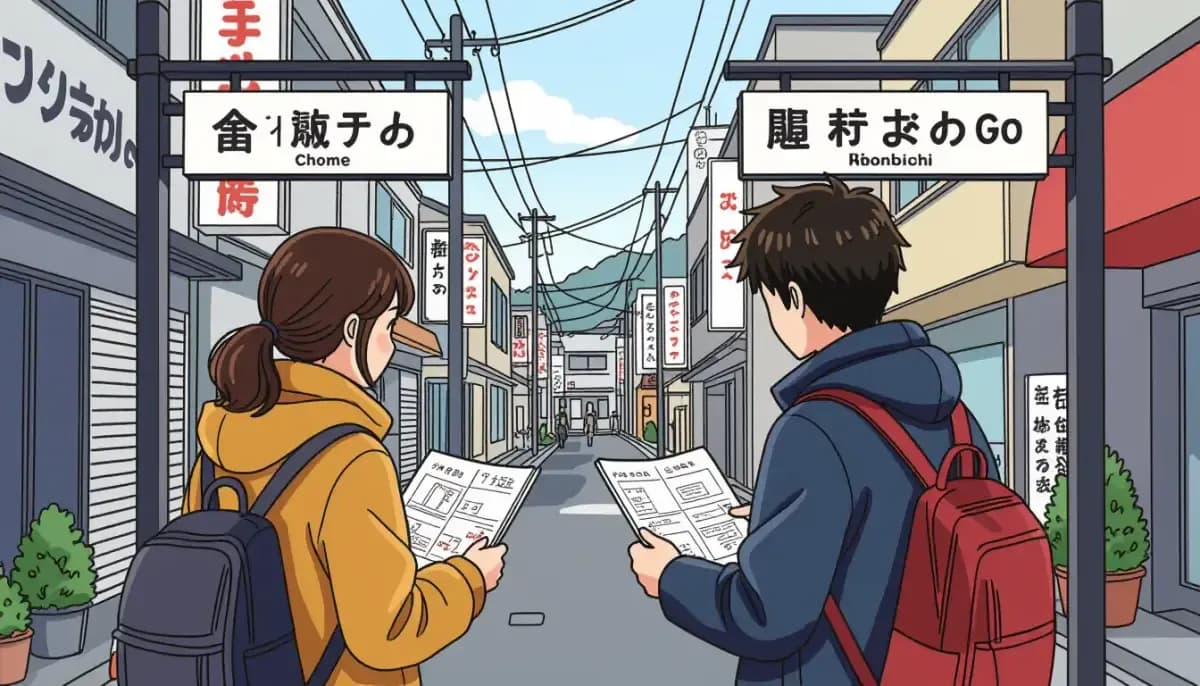
Learn how the Japanese address system works, how to read chome-ban-go addresses, write Japanese addresses in English, and navigate Japan as a foreigner. Full guide with examples.
Japanese Address System Explained for Foreigners
If you have ever stared at a Japanese address and felt completely lost, you are not alone. The Japanese address system works in a fundamentally different way from Western systems — there are no street names, numbers are assigned by registration order rather than geography, and the format reads from largest to smallest. For foreigners living in or moving to Japan, understanding this system is essential for receiving mail, registering your residence, and navigating daily life.
This guide breaks down everything you need to know about the Japanese address system, from reading and writing addresses to practical tips for daily life.
!Japanese address system map with chome banchi go street signs in Japan

How the Japanese Address System Works: The Basics
Unlike Western countries where addresses are built around street names (e.g., 123 Main Street), Japan uses an area-based system. Addresses flow from the largest geographic unit down to the smallest, following this hierarchy:
- Postal code (郵便番号, yuubin bangou)
- Prefecture (都道府県, todoufuken)
- City, ward, or town (市区町村, shikuchouson)
- Neighborhood or district (丁目, chome)
- Block number (番, ban or 番地, banchi)
- Building number (号, go)
- Building name and apartment number (if applicable)
The key thing to understand is that Japanese streets are almost never named and are never part of an official address. Instead, cities are divided into numbered blocks and sub-blocks. This means you cannot follow the traditional Western approach of finding a street and then counting house numbers.
Exceptions exist — Kyoto's famous grid system uses street names, and Sapporo also has a numbered grid system — but for the vast majority of Japan, the block system rules.
For more guidance on navigating daily life in Japan as a foreigner, see our Complete Guide to Daily Life in Japan.
Breaking Down the Key Components
Understanding each part of a Japanese address makes the whole system much more manageable. Here is a detailed breakdown:
Postal Code (〒 XXX-XXXX)
Japan introduced postal codes in 1968, making it one of the earlier countries to adopt them. Japanese postal codes are seven digits long, formatted as XXX-XXXX, and are always preceded by the 〒 symbol.
When filling out forms online or at government offices, you will typically select your prefecture from a dropdown, then enter your postal code to auto-fill the rest of the address. This makes registration much easier once you learn your code.
Prefecture (都道府県)
Japan has 47 prefectures divided into four administrative categories:
- 都 (to) — Metropolis (only Tokyo)
- 道 (do) — Territory (only Hokkaido)
- 府 (fu) — Urban prefecture (Osaka and Kyoto)
- 県 (ken) — Regular prefecture (all others)
City, Ward, or Municipality (市区町村)
Within each prefecture, areas are divided into:
- 市 (shi) — City
- 区 (ku) — Ward (used within Tokyo's 23 special wards)
- 町 (cho/machi) — Town
- 村 (son/mura) — Village
- 郡 (gun) — County (a grouping of smaller towns and villages)
Chome, Ban, and Go (丁目番号)
This is the heart of the Japanese address system and the part that confuses foreigners most. It consists of three layers:
- 丁目 (chome) — A district within a neighborhood. Chome numbers indicate your proximity to the center of the municipality.
- 番 (ban) / 番地 (banchi) — A block within that district. Importantly, block numbers were historically assigned in the order they were registered, not in geographic sequence. This means adjacent numbers may not be physically adjacent — especially in older parts of cities.
- 号 (go) — A specific building on that block. Go numbers were either assigned based on when buildings were constructed or in clockwise order around the block.
In practice, these three numbers are often combined with hyphens: for example, 3-5-8 means chome 3, block 5, building 8.
The residential address system was officially standardized in 1962 through the Act on Indication of Residential Address, which introduced this three-level system to replace the irregular banchi-only system from the Meiji Period.
How to Read a Japanese Address: Two Formats
There are two formats you will encounter depending on whether the address is written in Japanese (kanji) or in romanized letters (romaji).
Japanese Format (Largest to Smallest)
In Japanese, addresses are written from largest to smallest geographic unit. Reading from left to right, a typical address breaks down as:
- Postal code (e.g., 〒150-0001)
- Prefecture (e.g., 東京都 = Tokyo Metropolis)
- Ward (e.g., 渋谷区 = Shibuya Ward)
- Neighborhood (e.g., 神宮前 = Jingumae)
- Block numbers (e.g., 1丁目2番3号 = Chome 1, Block 2, Building 3)
- Building name (e.g., 山田ビル = Yamada Building)
- Room number (e.g., 401号室 = Room 401)
English/Romaji Format (Smallest to Largest)
When writing the same address in English, the order reverses to start from the most specific and go to the most general:
Room 401, Yamada Building, 1-2-3 Jingumae, Shibuya-ku, Tokyo 150-0001, Japan
This reverse order mirrors how English-speaking countries write addresses, and is what you should use when sending international mail or filling out English-language forms.
For more detail on navigating paperwork in Japan, see our guide on Banking and Finance in Japan.
Address Formats at a Glance
| Component | Japanese | Romaji | Example |
|---|---|---|---|
| Postal Code | 郵便番号 | Yuubin Bangou | 〒150-0001 |
| Prefecture | 都/道/府/県 | To/Do/Fu/Ken | 東京都 (Tokyo-to) |
| City/Ward | 市/区/町/村 | Shi/Ku/Cho/Mura | 渋谷区 (Shibuya-ku) |
| District | 丁目 | Chome | 1丁目 (1-chome) |
| Block | 番/番地 | Ban/Banchi | 2番 (Ban 2) |
| Building | 号 | Go | 3号 (Go 3) |
| Building Name | ビル/マンション | Biru/Manshon | 山田ビル |
| Room/Floor | 号室/階 | Goushitsu/Kai | 401号室 |
Practical Tips for Foreigners
Finding Your Address After Moving In
When you move into a new home in Japan, one of your first tasks will be resident registration (住民登録, juumin touroku) at your local city hall or ward office. You will need to register your address, and the landlord or real estate agent should provide your full Japanese address. If you are unsure, the 住居表示 (jukyo hyoji) — residential address indication — is often posted near your building entrance or on your mailbox.
For more on the process of moving in, see our Complete Guide to Finding Housing in Japan.
Getting Around When You Are Lost
Because Japanese addresses do not correspond to physical locations the way Western ones do, GPS and map apps are essential. Google Maps works excellently in Japan and allows you to search in English. When you enter an address, the map will pinpoint your destination accurately.
Police boxes (交番, koban) located near major train stations are also extremely helpful when you are lost. Officers there are accustomed to helping people with directions.
Verbally Sharing Your Address
When saying your address on the phone — for example, to a delivery company — pronounce the hyphenated numbers with の (no) between each: 1-2-3 becomes ichi no ni no san.
Receiving Packages and Mail
Japan has excellent delivery service, but it helps to know a few terms:
- 宛名 (atena) — Recipient name
- 宛先 (atesaki) — Delivery address
- 送り主 (okurinushi) — Sender
- 住所 (juusho) — Address
- 不在票 (fuzai-hyo) — Missed delivery slip
When expecting a package, you can usually reschedule delivery through a QR code on the missed delivery slip or the delivery company's website.
!Foreigner receiving a package at a Japanese apartment building

Writing a Japanese Address on Mail and Official Documents
On Japanese Envelopes
For vertical Japanese envelopes, write the address vertically from top to bottom on the right side of the envelope. The postal code goes in the boxes at the top right.
For horizontal envelopes, write left to right with the postal code first.
Always use 様 (sama) after the recipient's name for formal correspondence — this is the polite address title used in Japanese.
On International Mail Sent to Japan
When sending mail from abroad to a Japanese address, write the address in English (romaji) format: start with the apartment/room number, then building name, then the three-number block code, then neighborhood, ward/city, prefecture, postal code, and finally JAPAN in capital letters.
The Japanese postal system handles international mail efficiently, and addresses written in either format (Japanese or romaji) are typically delivered successfully.
Understanding Why Japanese Addresses Seem Random
One of the most puzzling aspects for foreigners is that building numbers within a block do not follow a logical geographic order. House number 5 might be on the opposite side of the block from house number 6. This is because:
- The banchi system originated in the Meiji Period (1873) following the Land Tax Reform, when lot numbers were assigned in the order they were registered for taxation purposes — not by location.
- Over time, as cities grew and land was subdivided, new numbers were added in registration order.
- The 1962 standardization introduced the chome-ban-go system, but older banchi assignments were largely retained.
In practice, this means that finding an address requires a map, not just knowing the number sequence. Even Japanese people rely on maps and landmarks when searching for addresses in unfamiliar areas.
For navigating Japan's transport system, see our Complete Guide to Transportation in Japan.
Useful Resources for Managing Japanese Addresses
Several online tools make dealing with Japanese addresses much easier for foreigners:
- Japan Post's postal code search tool allows you to look up any address using the 7-digit postal code
- Google Maps Japan provides accurate navigation even for complex block systems
- Address auto-complete on most Japanese e-commerce sites fills in your address after you enter the postal code
For more tips on settling into Japan, check out these helpful resources:
- Living in Nihon — resources for foreigners in Japan
- For Work in Japan — job and living guide for expats
- Ittenshoku — IT careers and life in Japan
- Practical Guide to the Japanese Address System — NihongoNana
- Japanese Address Format — Japan Manifest
- How to Read and Write Japanese Addresses — PLAZA HOMES
Quick Reference: Japanese Address Vocabulary
Knowing these key terms will help you manage addresses in everyday situations:
| Japanese | Romaji | Meaning |
|---|---|---|
| 住所 | juusho | Address |
| 郵便番号 | yuubin bangou | Postal code |
| 都道府県 | todoufuken | Prefecture |
| 市区町村 | shikuchouson | City/ward/town/village |
| 丁目 | chome | District |
| 番/番地 | ban/banchi | Block |
| 号 | go | Building number |
| 号室 | goushitsu | Room number |
| 階 | kai | Floor |
| ビル | biru | Building (office/commercial) |
| マンション | manshon | Apartment building |
| アパート | apaato | Apartment (usually older/smaller) |
| 住居表示 | jukyo hyoji | Residential address indication |
Summary
The Japanese address system is logical once you understand its structure. Rather than using street names, Japan divides areas into blocks using the chome-ban-go hierarchy, reading from largest to smallest geographic unit. Although the numbering within blocks can seem random due to the historical registration-based assignment system, modern map tools make navigation straightforward.
Key takeaways:
- Japanese addresses flow from prefecture to city to district (chome) to block (ban) to building (go)
- Postal codes are 7 digits and auto-fill most address forms
- Building and block numbers are not geographically sequential
- English/romaji format reverses the order compared to Japanese format
- Always use GPS maps to navigate to specific addresses
Once you have your registered address after completing residency registration, understanding the system will help you with everything from online shopping to utility registrations. For more guidance on getting settled, explore our Complete Guide to Moving to Japan.

Originally from Vietnam, living in Japan for 16+ years. Graduated from Nagoya University, with 11 years of professional experience at Japanese and international companies. Sharing information about living in Japan for foreigners.
View Profile →Related Articles

Seasonal Clothing Guide for Living in Japan
Complete seasonal clothing guide for foreigners living in Japan. Learn what to wear in spring, summer, rainy season, autumn, and winter with month-by-month tips and shopping advice.
Read more →
Japanese Convenience Store Life Hacks for Foreigners
Discover the best konbini life hacks for foreigners in Japan — from ATM tips and bill payments to discount food strategies, package delivery, and printing services at 7-Eleven, FamilyMart, and Lawson.
Read more →
Neighborhood Association Chonaikai Guide for Foreigners
Everything foreigners need to know about Japan's chonaikai (neighborhood associations): fees, how to join, what happens at meetings, garbage rules, and practical tips for expats.
Read more →
How to Furnish Your Japan Apartment on a Budget
Complete guide to furnishing your Japan apartment on a budget. Covers Nitori, IKEA, secondhand recycle shops, Sayonara Sales, and must-know tips for foreigners setting up their first Japanese apartment.
Read more →
Laundry Tips and Coin Laundry Guide in Japan
Complete guide to doing laundry in Japan: how to use coin laundries, decode Japanese washing machines, understand prices, payment methods, and laundromat etiquette for foreigners and expats.
Read more →
Garbage Collection and Disposal Rules in Japan
Learn Japan garbage disposal rules for foreigners: how to sort burnable, non-burnable, and recyclable trash, collection schedules, special items, and tips for expats navigating the Japanese waste system.
Read more →