
Japan Dependent Visa for Family Members Guide

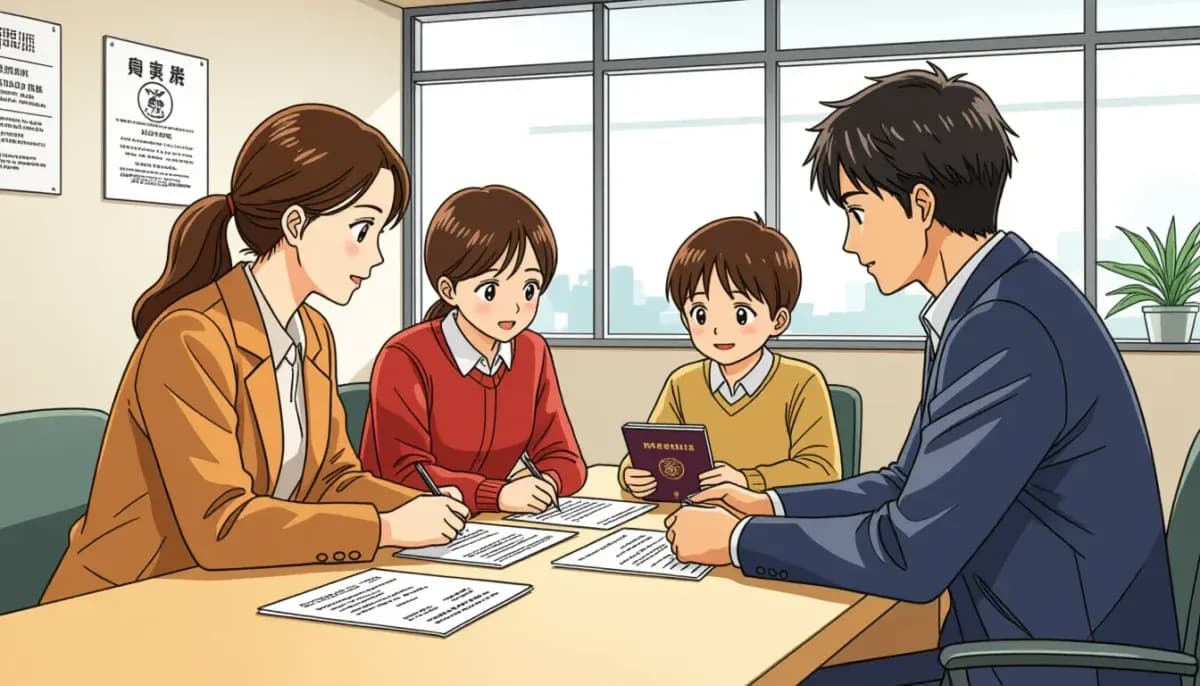
Complete guide to Japan's Dependent Visa for family members. Learn about eligibility, required documents, financial requirements, application process, work restrictions, and renewal procedures for bringing your spouse and children to Japan.
Japan Dependent Visa for Family Members: The Complete Guide
Bringing your family to Japan is one of the most important steps in building a life abroad. The Dependent Visa (also called the Family Stay visa) allows your spouse and children to live with you in Japan while you work or study. This guide covers everything you need to know about eligibility, required documents, the application process, costs, work restrictions, and renewal procedures.
If you are still deciding which visa type is right for you, check out our complete guide to Japan visa and immigration for a full overview of all available visa categories.
Who Is Eligible for a Dependent Visa?
The Japan Dependent Visa is strictly limited to the legally married spouse and children of a foreign national residing in Japan on a qualifying visa. Other relatives such as parents, siblings, or in-laws are not eligible, regardless of their financial dependency on the visa holder.
Key eligibility rules include:
- Spouses must be legally married. Common-law partners, fiancés, and domestic partners do not qualify.
- Children include biological children, legally adopted children, and recognized children. There is no strict age limit, but immigration may scrutinize applications for adult children.
- Same-sex partners are generally not recognized for dependent visa purposes under current Japanese law.
- The sponsor's children from a previous marriage may qualify only if they are legally adopted by the current sponsor.
Which Visa Types Can Sponsor Dependents?
Not all visa holders can sponsor dependents. Here is a breakdown:
| Sponsor's Visa Type | Can Sponsor Dependents? | Notes |
|---|---|---|
| Engineer/Specialist in Humanities | Yes | Most common sponsor visa |
| Instructor | Yes | Teaching at schools/universities |
| Intra-company Transferee | Yes | Corporate transfers |
| Business Manager | Yes | Company owners and managers |
| Researcher / Professor | Yes | Academic positions |
| University Student | Yes | Graduate and undergraduate |
| Technical School Student | Yes | Vocational schools |
| Japanese Language School Student | No | Cannot sponsor dependents |
| Technical Intern Trainee | No | Not eligible |
| Specified Skilled Worker (i) | No | Category 1 cannot sponsor |
| Specified Skilled Worker (ii) | Yes | Category 2 allows dependents |
For more details on working in Japan as a foreigner, see our dedicated guide.
Required Documents for the Dependent Visa Application
The application process begins with obtaining a Certificate of Eligibility (COE) from Japan's Immigration Services Agency. The sponsor in Japan submits the COE application on behalf of their family members.
Documents the Sponsor Needs to Prepare
- COE application form (available from the Immigration Bureau website)
- Passport copy of the sponsor
- Residence card copy of the sponsor
- Certificate of employment or enrollment
- Income tax certificate (課税証明書) and tax payment certificate (納税証明書)
- Bank statements showing sufficient savings
- A letter explaining why you are inviting your family
Documents the Dependent Needs to Prepare
- Valid passport
- Passport-sized photograph (30mm x 40mm, taken within 6 months)
- Marriage certificate (for spouses) or birth certificate (for children)
- Certified Japanese translation of all foreign-language documents
- Self-addressed return envelope with 392-yen stamps (for mail-back of COE)
All documents must be original or certified copies. Incomplete applications are the most common reason for delays. For general tips on moving to Japan, our relocation guide covers what to expect.
Financial Requirements: How Much Income Do You Need?
Immigration authorities evaluate whether the sponsor can financially support the dependent family members. While there is no legally fixed minimum income, the following benchmarks are commonly applied:
| Number of Dependents | Recommended Annual Income | Monthly Equivalent |
|---|---|---|
| 1 dependent | ¥3,000,000+ | ¥250,000/month |
| 2 dependents | ¥4,000,000+ | ¥333,000/month |
| 3+ dependents | ¥5,000,000+ | ¥416,000/month |
An alternative benchmark used by some immigration offices is approximately ¥80,000 per person per month as the minimum financial threshold.
If your income is slightly below these thresholds, you may still be approved if you can demonstrate:
- Significant savings in your bank account
- Stable employment with a reputable company
- Company-provided housing or other benefits that reduce living costs
Understanding the cost of living in Japan will help you plan your family budget and demonstrate financial readiness.
The Application Process Step by Step
Here is the complete timeline from start to finish:
Step 1: Gather Documents (2-4 weeks) Collect all necessary documents from both Japan and your home country. Foreign documents must be translated into Japanese by a certified translator.
Step 2: Submit COE Application (1-3 months processing) The sponsor submits the COE application at the nearest regional immigration bureau in Japan. Processing typically takes 1 to 3 months depending on the bureau's workload.
Step 3: Receive COE and Send to Family Once approved, the COE is mailed to the sponsor. The sponsor then sends the original COE (or provides the electronic version) to the family member abroad.
Step 4: Apply for Visa at Embassy (1-2 weeks) The family member takes the COE to the nearest Japanese embassy or consulate and applies for the Dependent Visa. Processing usually takes 5 business days to 2 weeks.
Step 5: Enter Japan and Register After arriving in Japan, the dependent must register at the local city or ward office within 14 days and obtain a residence card. They should also enroll in Japan's healthcare system and the national pension system.
Application Costs
- COE application: Free
- Visa issuance at embassy: ¥3,000 - ¥6,000 (varies by country)
- Document translation: ¥3,000 - ¥10,000 per document
- Certified copies and apostilles: varies by country
Work Restrictions for Dependent Visa Holders
Dependent visa holders cannot work by default. To engage in any paid employment, you must apply for a "Permission to Engage in Activity Other Than That Permitted Under the Status of Residence Previously Granted" (資格外活動許可).
Key work rules:
- Maximum 28 hours per week of part-time work
- During school holidays (for student sponsors), dependents may work up to 40 hours per week
- Prohibited industries include adult entertainment, gambling, and certain nightlife establishments
- Self-employment and freelance work require a separate work visa
If you want to work full-time in Japan, you will need to change your visa status to a proper work visa. For information about banking and finances in Japan, see our comprehensive guide.
Renewing and Extending Your Dependent Visa
The Dependent Visa is granted for periods of 6 months, 1 year, 3 years, or 5 years, generally matching the sponsor's visa duration. Renewal must be completed before the current visa expires.
Renewal Timeline and Tips
- Apply at least 2-3 months before expiration at the Immigration Bureau
- Processing takes approximately 2 weeks to 2 months
- You can legally remain in Japan while your renewal is being processed (you will receive a stamp in your passport)
Documents Needed for Renewal
- Extension application form
- Passport and residence card
- Updated income and tax certificates from the sponsor
- Proof of continued relationship (living together, shared address)
- For children: school enrollment certificates
If you fail to renew before expiration, you may be considered an overstayer, which can result in deportation and a ban from re-entering Japan.
Common Mistakes and How to Avoid Them
Many applicants run into preventable problems. Here are the most frequent issues:
- Insufficient income documentation - Always provide tax certificates, not just pay slips. Immigration wants to see your official taxable income.
- Missing translations - Every foreign-language document must have a certified Japanese translation attached.
- Applying too late for renewal - Start the renewal process at least 3 months before your visa expires.
- Not updating your address - If you move, you must report your new address to the ward office within 14 days.
- Working without permission - Working even one hour without the proper work permit is a visa violation.
For a comprehensive look at daily life in Japan, including registering at city hall and setting up utilities, our daily life guide has you covered.
Transitioning from Dependent Visa to Other Visa Types
Many dependents eventually want to transition to a different visa status. Common transitions include:
- Dependent to Work Visa: If you find full-time employment and meet the qualifications for a work visa category
- Dependent to Spouse of Japanese National: If you marry a Japanese citizen
- Dependent to Permanent Resident: After living in Japan for 10+ years (or shorter with certain conditions)
- Dependent to Long-Term Resident: In special circumstances such as divorce with children who are enrolled in Japanese schools
Each transition requires a Change of Status of Residence application, which is processed at the immigration bureau. For those considering long-term settlement, our guide to marriage and relationships in Japan provides important context.
Helpful Resources and External Links
Navigating the Japanese immigration system can be complex. Here are some trusted resources:
- The Ministry of Foreign Affairs visa page provides official requirements for dependent visas
- Coto Academy's Dependent Visa Guide offers a detailed 2026 walkthrough
- TranSenz's guide to dependent visas covers edge cases and practical tips
- For broader visa and residency information, visit Living in Nihon's visa guide
- If you are bringing family for work purposes, For Work in Japan's family guide covers family life topics
- For career-related information in Japan's IT industry, Ittenshoku provides comprehensive resources
Frequently Asked Questions
Can my parents get a Dependent Visa? No. The Dependent Visa is only available to spouses and children. Parents may visit on a short-term visitor visa (up to 90 days) or apply for a Designated Activities visa in special medical care situations.
Can I change my Dependent Visa to a work visa? Yes, if you meet the requirements for a specific work visa category (such as having a bachelor's degree or 10+ years of experience), you can apply for a Change of Status of Residence.
What happens if the sponsor and I divorce? You will lose eligibility for the Dependent Visa. However, if you have children enrolled in Japanese schools, you may be able to apply for a Long-Term Resident visa. Consult an immigration lawyer promptly.
Can I start a business on a Dependent Visa? No. Self-employment requires a Business Manager visa. You may only do part-time work (up to 28 hours/week) with permission on a Dependent Visa.
How long does the entire process take? From gathering documents to arrival in Japan, expect approximately 3 to 5 months total. The COE processing (1-3 months) is typically the longest step.
Bringing your family to Japan is a rewarding but paperwork-intensive process. Start early, keep your documents organized, and do not hesitate to consult an immigration lawyer if your situation is complex. For more guides on building your life in Japan, explore our complete guide to raising children in Japan and our guide to taxes in Japan.

Originally from Vietnam, living in Japan for 16+ years. Graduated from Nagoya University, with 11 years of professional experience at Japanese and international companies. Sharing information about living in Japan for foreigners.
View Profile →Related Articles

Japan Designated Activities Visa Guide
Complete guide to Japan's Designated Activities visa covering job hunting, No. 46, J-FIND, digital nomad, and working holiday categories with requirements and application steps for foreigners.
Read more →
Japan Long Term Resident Visa Explained
Everything you need to know about Japan's Long-Term Resident Visa (teijusha): eligibility categories, application process, required documents, and how it compares to permanent residency.
Read more →
How to Change Your Visa Status in Japan
Complete guide to changing your visa status of residence in Japan. Learn the step-by-step application process, required documents, fees, processing timeline, and 2025-2026 immigration updates for foreigners.
Read more →
Common Japan Visa Application Mistakes to Avoid
Discover the most common Japan visa application mistakes that lead to rejection. Learn how to avoid documentation errors, wrong visa categories, and weak financial proof to get approved.
Read more →
Japan Business Manager Visa Requirements and Process
Complete guide to Japan's Business Manager Visa in 2026. Learn about the new 30 million yen capital requirement, application process, documents needed, and tips for approval as a foreign entrepreneur.
Read more →
Working Holiday Visa Japan Complete Guide
Everything you need to know about Japan's Working Holiday Visa: eligible countries, age requirements, application process, work rules, costs, and tips for making the most of your WHV experience.
Read more →