
How to Interact with Japanese Police as a Foreigner

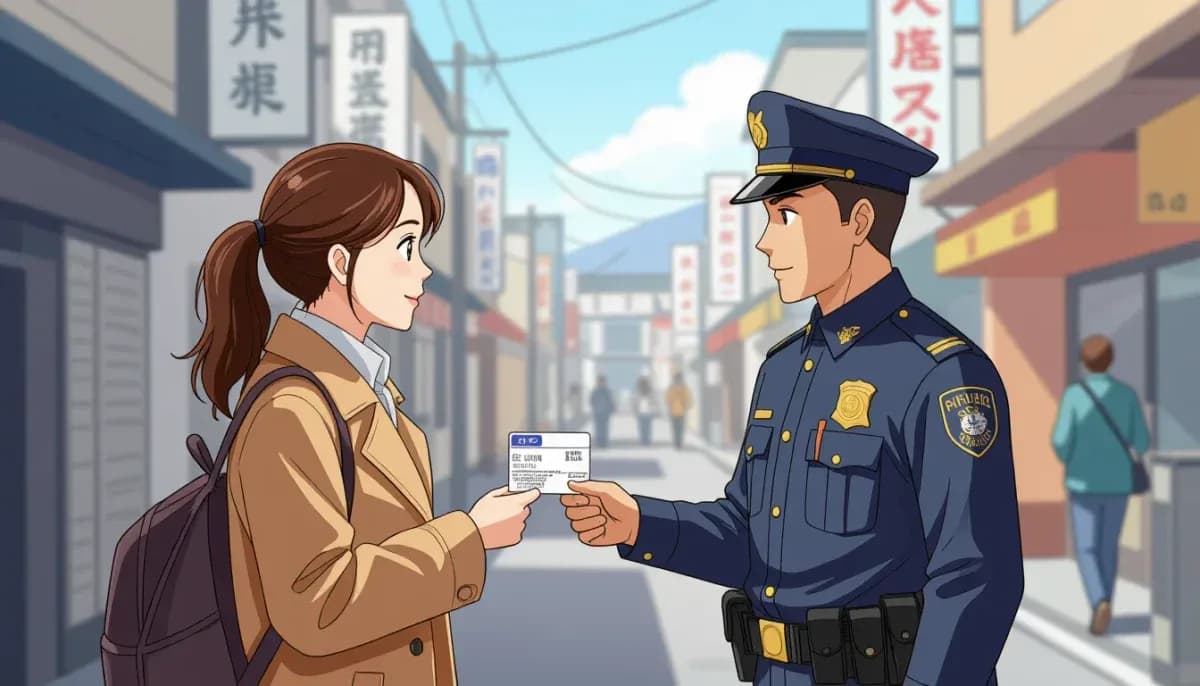
Complete guide for foreigners on interacting with Japanese police: what ID to carry, your rights during stops, what happens if arrested, how to contact your embassy, and practical tips to stay safe in Japan.
How to Interact with Japanese Police as a Foreigner: A Complete Guide
Whether you're a tourist exploring Japan for a few weeks or a long-term resident building your life here, knowing how to interact with Japanese police is essential knowledge. Japan is widely considered one of the safest countries in the world, but encounters with law enforcement can happen — and how you handle them can make all the difference.
This guide covers everything from routine police stops to what happens if you're detained or arrested, giving you the confidence to navigate these situations calmly and correctly.
!A foreigner politely showing their residence card to a Japanese police officer on a city street

Understanding the Japanese Police System
Japan's police force (警察, keisatsu) is organized both at the national and prefectural level. The National Police Agency (NPA) sets policy and standards, while each prefecture has its own police department. You'll most commonly interact with officers at neighborhood police boxes called koban (交番) — small stations found throughout cities where officers patrol on foot or by bicycle.
Japanese police officers are generally known for being professional and courteous. However, they operate within a legal system that gives them significant powers, especially around detention and interrogation. Understanding the system before you need it is far better than learning on the fly.
Key things to know about the Japanese police:
- Koban officers handle minor issues, lost property, and neighborhood safety
- Prefectural police handle criminal investigations
- The system is highly organized with clear hierarchies
- Police reports and interactions are extensively documented
For a broader understanding of Japan's legal landscape for foreigners, see Living in Nihon's guide to legal issues in Japan.
Why Foreigners Are Stopped More Often: The Reality of Racial Profiling
One uncomfortable truth for foreigners in Japan is that you may be stopped by police more frequently than your Japanese neighbors — simply because you look foreign.
According to a 2022 survey by the Tokyo Bar Association of 2,094 foreign residents:
- 62.9% had been questioned by police in the previous five years
- 85% felt they were targeted due to their appearance
- 77% believed their perceived "foreignness" was the primary reason for stops
In 2024, three foreign residents filed a landmark lawsuit against Japanese police, alleging systematic racial profiling. One plaintiff of Indian descent reported being questioned by police at least 70 times since 2002 — with an officer once stating it was "rare to see foreigners driving." Human Rights Watch documented these cases, and the issue received significant international attention.
The Japanese government's response has been cautious. The National Police Agency acknowledged finding six cases of "inappropriate" conduct in 2021 but maintained there is no race-based policy. Japan's constitution explicitly bans racial discrimination, and Japan is a signatory to the International Convention on the Elimination of All Forms of Racial Discrimination.
What this means for you: Being stopped doesn't mean you've done anything wrong. Knowing your rights and staying calm will get you through most interactions quickly and without incident.
What to Do When Stopped by Police
Police in Japan have the authority to stop and question individuals they have reasonable cause to suspect. For foreigners, this often means being asked to show identification. Here's exactly how to handle it:
Step 1: Stay Calm and Be Polite
Japanese culture places enormous value on respectful interaction. Raising your voice, making sudden movements, or showing visible frustration can escalate a routine stop into something more serious. A calm demeanor, a slight bow, and polite language go a long way.
- Speak quietly and calmly
- Keep your hands visible
- Make no sudden movements
- A small bow shows respect
Step 2: Present Your Identification
You are legally required to carry identification at all times in Japan:
- Tourists: Must carry your passport at all times
- Residents: Must carry your Residence Card (Zairyu Card, 在留カード) at all times
Failure to carry the correct ID can result in detention and a fine of up to ¥200,000. A copy of your passport or driver's license is not an acceptable substitute.
Step 3: Understand What You Can and Cannot Do
You have the right to ask why you are being stopped. You also have the right to record the interaction for later complaint purposes — though doing so openly may escalate tension. If you believe the stop is inappropriate, the recommended approach is to note details and file a complaint afterward rather than confronting the officer directly.
You cannot legally refuse to present identification during a lawful stop. Refusal can constitute interference with police duties.
Step 4: Answer Basic Questions Cooperatively
Police may ask your name, nationality, where you live, what you're doing in the area, and where you work. Cooperative answers to these basic questions will typically end the stop quickly. You are not obligated to answer questions beyond confirming your identity.
If you don't speak Japanese, you can say:
- "英語しか話せません" (Eigo shika hanasemasen) — "I only speak English"
- Police may call an interpreter or use a translation app
!Foreigner at a koban police box in Japan asking for directions

Things That Can Get You in Trouble with Japanese Police
Many foreigners are surprised by what's illegal or restricted in Japan. Being unaware of these rules is not a legal defense.
| Prohibited Item/Behavior | Details |
|---|---|
| Carrying codeine medication | Common in OTC cold medicine abroad; illegal in Japan |
| Pseudoephedrine | Found in some allergy/cold medications; prohibited |
| Cannabis (marijuana) | Strictly illegal; zero tolerance regardless of origin |
| Knives over 2.25 inches | Including folding knives and multi-tools |
| MDMA/stimulants | Extremely strict enforcement; deportation likely |
| Public intoxication/nuisance | Can result in police intervention |
| Unregistered bicycle | May be stopped to verify ownership |
| Overstaying your visa | Immigration violation; police may be involved |
Medication warning: Always check whether your prescription or OTC medications are legal in Japan before traveling. The Ministry of Health, Labour and Welfare has an online database for checking. Certain ADHD medications, sleeping pills, and pain relievers contain controlled substances in Japan.
If you're unsure about your medications or other legal questions, For Work in Japan's labor law guide covers workplace-related legal rights that may also be useful.
Your Rights During Detention and Arrest
If you are detained or arrested in Japan, the situation becomes significantly more serious. Japan's criminal justice system operates very differently from Western systems, and understanding it in advance could protect your rights.
The Detention Timeline
Under Japanese law, police can hold you for an extended period without formal charges:
| Stage | Duration | Authority |
|---|---|---|
| Initial arrest | Up to 48 hours | Police |
| Prosecutor's extension | Up to 10 days | Court-approved |
| Second extension | Up to 10 more days | Court-approved |
| Maximum without charge | Up to 23 days | Possible |
| After charges | Bail possible | Court discretion |
This extended detention without charges — sometimes called "hostage justice" — is a significant concern. Critics note that the system can pressure innocent people into false confessions.
Rights You Have When Arrested
- Right to remain silent: You must be informed of this right upon arrest. Use it.
- Right to an attorney: You can request a public defender or hire a private attorney
- Right to consular notification: Under the Vienna Convention, you have the right to have your embassy or consulate notified of your arrest — assert this right immediately
- Right to an interpreter: You have the right to have an interpreter present for interrogations
Important Restrictions to Know
- No phone calls: Unlike many Western countries, you cannot call family, friends, or employers after arrest
- No attorney during interrogation: Your lawyer can advise you before and after sessions, but cannot be present during questioning
- Letters are monitored: All correspondence in detention is examined by police; foreign-language letters are prohibited
- Interrogations are mandatory: You must attend interrogations but you can remain silent
Bail Realities for Foreigners
Bail in Japan is only available after formal charges are filed — not during the initial detention period. For foreigners, obtaining bail is extremely difficult:
- Courts rarely grant bail to foreigners, especially on tourist visas
- Typical bail deposits: 2–3 million yen (approximately $13,000–$20,000 USD)
- Bail conditions often include not leaving Japan
For detailed arrest procedures, the U.S. Embassy guide to the first 72 hours after arrest is an essential resource.
Contacting Your Embassy: A Critical Step
If you are detained or arrested, notifying your embassy is one of the most important things you can do. This applies to all nationalities.
What your embassy can do:
- Visit you in detention to check on your welfare
- Provide a list of English-speaking attorneys in Japan
- Contact your family on your behalf
- Ensure you have access to medical care
- Intercede with authorities to ensure your rights are observed
- Facilitate money transfers for legal fees
What your embassy cannot do:
- Get you released
- Attend interrogations with you
- Pay for your legal defense
- Intervene in legal proceedings
Keep your embassy's emergency contact number saved in your phone and memorized. For U.S. citizens, the emergency line is available 24/7. Most major nations have similar emergency consular services.
Practical Tips for a Smooth Experience
Here are practical steps every foreigner in Japan should take proactively:
Before any incident:
- Always carry your valid ID (passport or Residence Card)
- Keep your embassy's emergency contact saved in your phone
- Note down the number for Japan Legal Support Center (Japan Horitsu Shien Center): 0570-078374
- Research whether your medications are legal in Japan before arrival
- Know the Japanese emergency numbers: 110 for police, 119 for fire/ambulance
If stopped:
- Stay calm, bow slightly, and cooperate
- Present your ID without argument
- If you don't understand something, say so — ask for an interpreter
- Note officer's badge number and details if you want to file a complaint later
If arrested:
- Immediately request your embassy be notified
- Request an attorney
- Exercise your right to silence until you have legal counsel
- Do not sign any documents without attorney review
For broader safety preparation in Japan, our guide on safety and emergency preparedness covers what to do in various emergency scenarios. You should also review Japanese culture and etiquette to understand the social norms that inform police interactions.
Common Misconceptions About Japanese Police
Misconception 1: "Police in Japan won't bother foreigners." While Japan has low overall crime rates, surveys show foreigners — especially those of non-Asian appearance — are stopped significantly more often than Japanese nationals.
Misconception 2: "Just show them your driver's license." Foreign driver's licenses and other ID are not valid alternatives to a passport or Residence Card for Japanese police stops.
Misconception 3: "I can refuse to cooperate and nothing will happen." Refusing to cooperate can be construed as interference with police duties. Cooperate first, complain through proper channels later.
Misconception 4: "I'll get a phone call when arrested." Japan does not have the same "one phone call" rule as in many Western countries. Your attorney becomes your primary link to the outside world.
Misconception 5: "The criminal justice system works like back home." Japan has a conviction rate exceeding 99%, partly attributed to the extended detention and interrogation system. Do not underestimate the seriousness of any criminal charge.
For more information about navigating Japan's systems as a foreigner, Ittenshoku's resources for foreigners in Japan offer useful perspective on legal and professional matters.
Finding Legal Help in Japan
If you find yourself needing legal assistance related to police or other legal matters:
| Resource | Details |
|---|---|
| Japan Legal Support Center (Houritsuka) | 0570-078374 — free consultations |
| JFBA (Japan Federation of Bar Associations) | Provides lawyer referrals |
| Your embassy or consulate | Lists of English-speaking lawyers |
| Tokyo English Life Line (TELL) | 03-5774-0992 — counseling and support |
| AMDA International Medical Information Center | 03-5285-8088 — multilingual support |
Many Japanese attorneys do not speak English, so specifically requesting English-speaking legal counsel through your embassy is important. Costs for private attorneys in criminal cases typically range from $6,000–$10,000 USD.
If you're dealing with workplace-related legal issues alongside police matters, our guide on working in Japan as a foreigner covers your employment rights in detail.
Final Thoughts
Japan remains one of the safest countries in the world for residents and visitors alike. The overwhelming majority of foreigners in Japan never have any negative interaction with police. However, preparation is the best protection — knowing what to carry, how to behave, and what your rights are means you can handle any situation with confidence rather than panic.
The key takeaways:
- Always carry valid ID — passport for tourists, Residence Card for residents
- Stay calm and cooperative during any police stop
- Know your embassy's emergency contact number
- Exercise your right to remain silent and to legal counsel if arrested
- Contact your embassy immediately if detained
For more resources on living and navigating life in Japan as a foreigner, explore our guides on daily life in Japan and healthcare in Japan.
For comprehensive information about police stops and foreigners' rights, see Japan Today's guide on being stopped by police in Japan and Izanau's detailed overview of arrest and interrogation procedures.

Originally from Vietnam, living in Japan for 16+ years. Graduated from Nagoya University, with 11 years of professional experience at Japanese and international companies. Sharing information about living in Japan for foreigners.
View Profile →Related Articles

Winter Safety Tips and Cold Weather Guide for Japan
Essential winter safety guide for foreigners in Japan: heating safety, hypothermia prevention, heat shock risks, layering tips, and emergency preparedness for cold weather.
Read more →
Heat Stroke Prevention in Japan Summer Safety Guide
Learn how to prevent heat stroke in Japan's brutal summer heat and humidity. Essential tips on hydration, symptoms, emergency numbers (119, #7119), and Japanese-specific heat prevention strategies for foreigners.
Read more →
How to Prepare for Volcanic Eruptions in Japan
Complete guide for foreigners on volcanic eruption preparedness in Japan. Learn the JMA 5-level alert system, build your emergency kit, and know what to do during an eruption or ash fall.
Read more →
Fire Safety and Prevention in Japan for Residents
Learn essential fire safety tips for living in Japan — from emergency number 119 and smoke detector laws to apartment evacuation routes and fire insurance. A complete guide for foreigners.
Read more →
Japan Emergency Alert System How It Works
Everything foreigners need to know about Japan's J-Alert emergency alert system: how it works, what the sounds mean, why your foreign phone may not receive it, and which apps to install for English alerts.
Read more →
Flood and Landslide Safety in Japan Guide
Everything foreigners need to know about flood and landslide safety in Japan: understanding the 5-level warning system, reading hazard maps, essential apps, evacuation steps, and building a disaster kit.
Read more →