
Child Allowance and Benefits in Japan for Foreign Families

Complete guide to child allowance (Jido Teate) and family benefits in Japan for foreigners. Learn about the 2024 reforms, payment amounts, eligibility, how to apply, daycare subsidies, and more.
Child Allowance and Benefits in Japan for Foreign Families
Japan offers a surprisingly generous set of government benefits for families with children — and the good news is that most of these benefits are available to foreign residents too. If you're raising children in Japan on a work visa, spouse visa, or other long-term residency status, you may be entitled to monthly child allowances, free healthcare for your kids, subsidized daycare, and more. This guide explains everything you need to know about child allowance and family benefits in Japan as a foreigner.
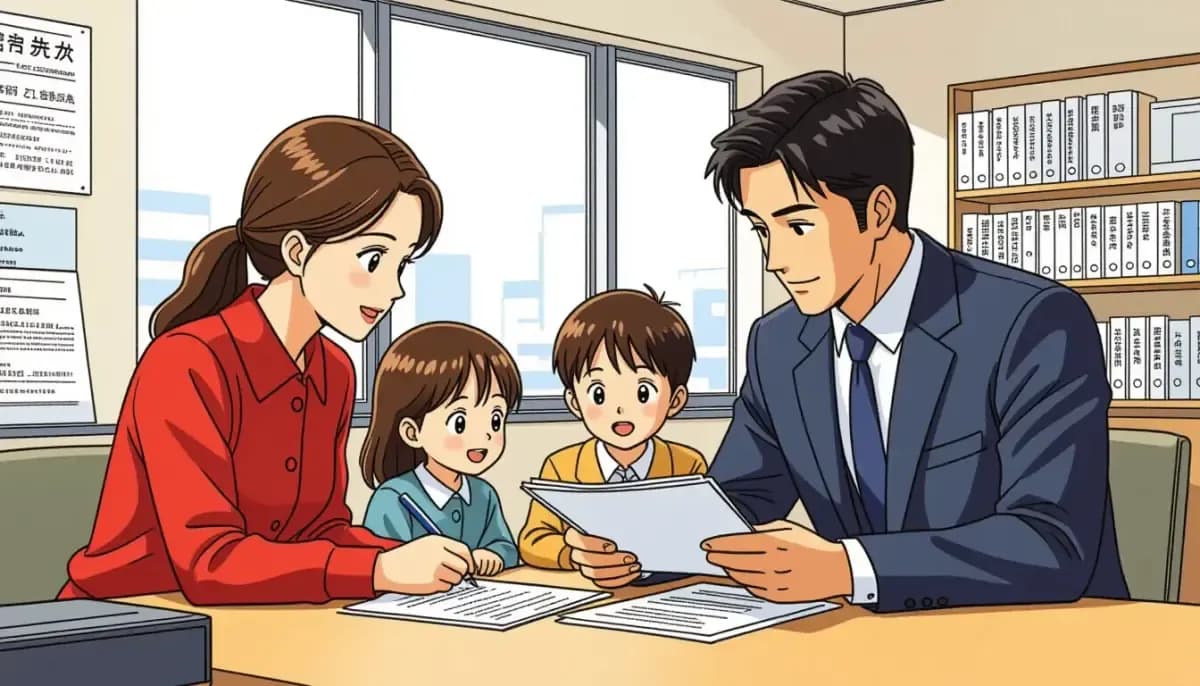
!Japanese family with children receiving child allowance benefits at a city hall office in Japan

What Is the Child Allowance (Jidō Teate)?
The Child Allowance (児童手当, Jidō Teate) is a monthly cash benefit paid by the Japanese government to families raising children. It was significantly expanded in October 2024, making it one of the most accessible and generous child benefit programs in Asia.
Key facts about the 2024 reform:
- Age eligibility extended: Now covers children from birth until the end of high school (age 18), up from the previous cutoff of age 15 (end of junior high school)
- Income limits abolished: Previously, high-income households received only ¥5,000/month or nothing. The income cap has been completely removed — all families now qualify regardless of earnings
- Higher rates for larger families: Families with three or more children receive double the standard rate
As a foreigner living in Japan, you are eligible for the child allowance as long as you hold valid residency status and are registered as a resident in your municipality. Your child's nationality does not matter — foreign children and dual nationals living in Japan qualify equally.
Child Allowance Payment Amounts (Post-October 2024)
Here is a breakdown of the monthly child allowance amounts under the updated system:
| Child's Age | 1st & 2nd Child | 3rd Child and Beyond |
|---|---|---|
| Under 3 years | ¥15,000/month | ¥30,000/month |
| Age 3 to high school completion | ¥10,000/month | ¥30,000/month |
Payment schedule: Allowances are paid 6 times per year — in February, April, June, August, October, and December. Each payment covers the two preceding months.
For example, a family with two children (ages 1 and 5) would receive:
- Child 1 (under 3): ¥15,000/month
- Child 2 (ages 3-18): ¥10,000/month
- Total: ¥25,000/month or ¥300,000/year
A family with three children would receive significantly more, with the third child earning ¥30,000/month regardless of age.
Who Is Eligible? Foreign Residents and the Child Allowance
Foreign nationals in Japan can receive the child allowance if they meet these conditions:
- Valid residency status: You must hold a mid- to long-term residence status (work visa, spouse visa, permanent residency, etc.). Short-term visitors and those without valid status do not qualify.
- Registered resident: You must be registered at your local municipal office (住民票, juminhyo).
- Raising children in Japan: The children must be living with you in Japan. Children living abroad are generally not eligible, with limited exceptions for children studying abroad who previously lived in Japan for at least 3 years.
There is no minimum length-of-residency requirement. Even newly arrived expats can apply shortly after arriving and registering their address.
For more information on registering your residence and understanding your rights as a foreign resident, see our guide on Japanese bureaucracy and paperwork for foreigners.
How to Apply for Child Allowance in Japan
Applying for the child allowance is straightforward but must be done promptly — payments begin from the month after your application, so every month you delay means missed benefits.
Where to apply: Visit the Childcare Support Section (子育て支援課, Kosodate Shien-ka) at your local city hall or ward office. Many wards also have Foreigner Support Desks or multilingual consultation services.
You can also apply online through the My Number Portal (マイナポータル) if you have a My Number Card.
Required documents:
- Residence Card (在留カード, Zairyu Card) of the applicant
- Health Insurance Certificate (健康保険証)
- Bank account passbook or account details for the transfer
- Birth certificate(s) of your child/children
Application deadline tip: Apply within 15 days of your child's birth or your arrival in Japan to maximize the benefits you receive.
!Documents needed to apply for child allowance in Japan

Beyond Child Allowance: Other Family Benefits in Japan
The child allowance is just one of several government support programs available to foreign families in Japan. Here is an overview of other key benefits:
Childbirth Lump Sum Allowance (出産育児一時金)
If you are enrolled in Japan's National Health Insurance (国民健康保険) or an employer-provided health insurance plan, you are entitled to a ¥500,000 one-time payment upon the birth of each child. This is meant to help offset delivery costs, which in Japan typically range from ¥350,000 to over ¥600,000.
This payment is often handled directly between your insurance and the hospital, meaning you may not need to pay the full delivery cost upfront.
Pediatric Medical Care Subsidies (子ども医療費助成)
Japan's pediatric medical care system is highly subsidized:
- Under age 3: Doctor visits are essentially free
- Ages 3 to high school: Maximum co-payment of ¥500 per visit (and free after two visits in the same month)
- Prescription medications for children are free
- Hospital admissions through high school completion are also heavily subsidized
You will receive a Children's Medical Certificate (子ども医療証, Kodomo Iryosho) from your ward office, which you present at clinics and hospitals. Apply for this when you register your child's birth.
Daycare and Kindergarten Subsidies (保育料無償化)
Since 2019, Japan has had a free early childhood education policy (幼児教育・保育の無償化):
- Licensed nurseries (認可保育所) for ages 0-2: Free for families meeting income criteria; subsidized for others. In Tokyo, these are broadly free for residents.
- Certified kindergartens and daycare (認定こども園) for ages 3-5: Free for all children regardless of income, including foreigners
- Private kindergartens (私立幼稚園): Tuition subsidized up to approximately ¥25,700/month
For unlicensed daycare facilities, many municipalities offer additional subsidies of ¥40,000 to ¥100,000/month depending on ward and child age.
Foreign families are fully eligible for these subsidies. Applications are submitted to the ward office's childcare services section.
Single-Parent Support (児童扶養手当)
Foreign single parents raising children in Japan may qualify for the Child Support Allowance (児童扶養手当), which provides up to approximately ¥50,000/month for the first child and around ¥10,000 for each additional child, until the child turns 18. Eligibility depends on income.
Tokyo-Specific Benefits for Foreign Families
If you live in Tokyo, you have access to additional benefits beyond the national programs:
- Tokyo 0-18 Support (018サポート): An additional ¥5,000/month per child under 18, funded by the Tokyo Metropolitan Government. This requires a separate application at your ward office and is in addition to the national child allowance.
- Free medical care through age 18: Tokyo extends free pediatric medical care through high school graduation for all residents.
- Expanded daycare subsidies: Many Tokyo wards offer subsidies for unlicensed daycare, which can range from tens of thousands to over ¥100,000 per month.
According to data from e-housing.jp, a family with two young children in Tokyo could save between ¥950,000 and ¥2,600,000 per year through the combination of all available benefits. For more details, see Tokyo Childcare Subsidies 2025: How Expats Can Save ¥1-2M Yearly.
For broader information on managing money in Japan, see our guide on banking and finance in Japan for foreigners.
Summary of Family Benefits Available to Foreign Residents in Japan
| Benefit | Amount | Eligibility |
|---|---|---|
| Child Allowance (Jidō Teate) | ¥10,000-¥30,000/month per child | All residents with valid visa |
| Tokyo 0-18 Support | ¥5,000/month per child | Tokyo residents only |
| Childbirth Lump Sum | ¥500,000 per birth | Health insurance enrollees |
| Daycare (ages 3-5) | Free (licensed facilities) | All residents |
| Pediatric Medical Care | Free or ¥500/visit max | All residents |
| Child Support Allowance | Up to ¥50,000/month | Single parents, income-based |
Practical Tips for Maximizing Your Family Benefits
- Register your address immediately: Benefits are calculated from the date of registration, not the date of arrival. Register at your ward office within 14 days of moving.
- Apply within 15 days of birth: The child allowance starts from the month after your application. Delaying means losing months of payments.
- Get a My Number Card: Having a My Number Card (マイナンバーカード) lets you apply for and manage benefits online through the My Number Portal, saving trips to the ward office.
- Ask for English support: Many ward offices have multilingual support. At the information counter, you can say "英語の通訳をお願いします" (Eigo no tsūyaku o onegaishimasu) to request an English interpreter.
- Check Tokyo-specific benefits: If you live in Tokyo, don't forget to apply for the 018 サポート (Tokyo 0-18 Support) separately — it's an easy ¥60,000/year per child that many expats miss.
- Keep documents updated: If your residence status changes or you move, update your records at the ward office promptly to avoid disruptions to benefit payments.
For more guidance on navigating Japanese bureaucracy and paperwork, check out resources at Living in Nihon and For Work in Japan, which offer helpful guides for foreign residents.
For job-related support and understanding your employee benefits in Japan, Ittenshoku is a valuable resource.
You can also find additional information about raising children in Japan in our comprehensive guide: The Complete Guide to Raising Children in Japan.
For healthcare-related questions beyond child benefits, see our Complete Guide to Healthcare in Japan for Foreigners.
Frequently Asked Questions
Q: Do I need to be a Japanese citizen to receive the child allowance? A: No. Foreign residents with valid residency status are eligible. Your child's nationality is irrelevant — even children of non-Japanese parents qualify if they live in Japan.
Q: What if my child was born before I moved to Japan? A: You can apply for the child allowance as soon as you register your address in Japan. Benefits start from the month after your application.
Q: Can I receive the child allowance if I'm on a short-term visa? A: Generally no. The child allowance is for residents with mid- to long-term residency status. Short-term visitors and tourist visa holders are not eligible.
Q: How is the "third child" counted? A: The third-child rate applies based on birth order, so if you have three children and the first two are over 18, the third child still qualifies for the higher rate under the post-2024 rules.
Q: What happens to my child allowance payments if I leave Japan? A: If you permanently leave Japan, you should notify your ward office and payments will stop. Children living abroad (except those studying overseas under specific conditions) are not eligible.
For the most up-to-date information, always check with your local ward or city office, as benefit amounts and eligibility rules can change. The information in this article reflects the system as of 2025-2026, including the October 2024 reforms.
For additional details on Japan's social safety net and financial resources for foreigners, check out RetireWiki's guide to Childcare Allowance and GaijinPot's overview of government subsidies.

Originally from Vietnam, living in Japan for 16+ years. Graduated from Nagoya University, with 11 years of professional experience at Japanese and international companies. Sharing information about living in Japan for foreigners.
View Profile →Related Articles

Summer Activities and Programs for Kids in Japan
Complete guide to summer activities and programs for kids in Japan. Discover English camps, traditional festivals, water sports, theme parks, and indoor activities for expat families.
Read more →
Special Needs Education in Japan for Foreign Families
A complete guide to special needs education in Japan for foreign families. Learn about school types, support levels, enrollment process, international school options, and key resources for expat parents.
Read more →
Is Homeschooling Legal in Japan Guide for Foreigners
Is homeschooling legal in Japan for foreigners? Learn about the legal gray area, steps to homeschool your child, curriculum options, and support organizations for expat families in Japan.
Read more →
Japanese Education System Explained for Foreign Parents
A complete guide to Japan's education system for foreign parents. Learn about school types, enrollment steps, costs, language support, and tips for raising bilingual children in Japan.
Read more →
Dealing with Bullying Ijime in Japanese Schools
Learn how to recognize, report, and respond to ijime (bullying) in Japanese schools. A practical guide for foreign and expat parents in Japan, with key statistics and action steps.
Read more →
After School Activities and Juku in Japan for Kids
Complete guide to after-school activities (naraigoto) and juku cram schools in Japan for expat families. Learn about costs, enrollment, popular activities, and tips for foreign children.
Read more →