
Buying Home Appliances in Japan Guide for Foreigners

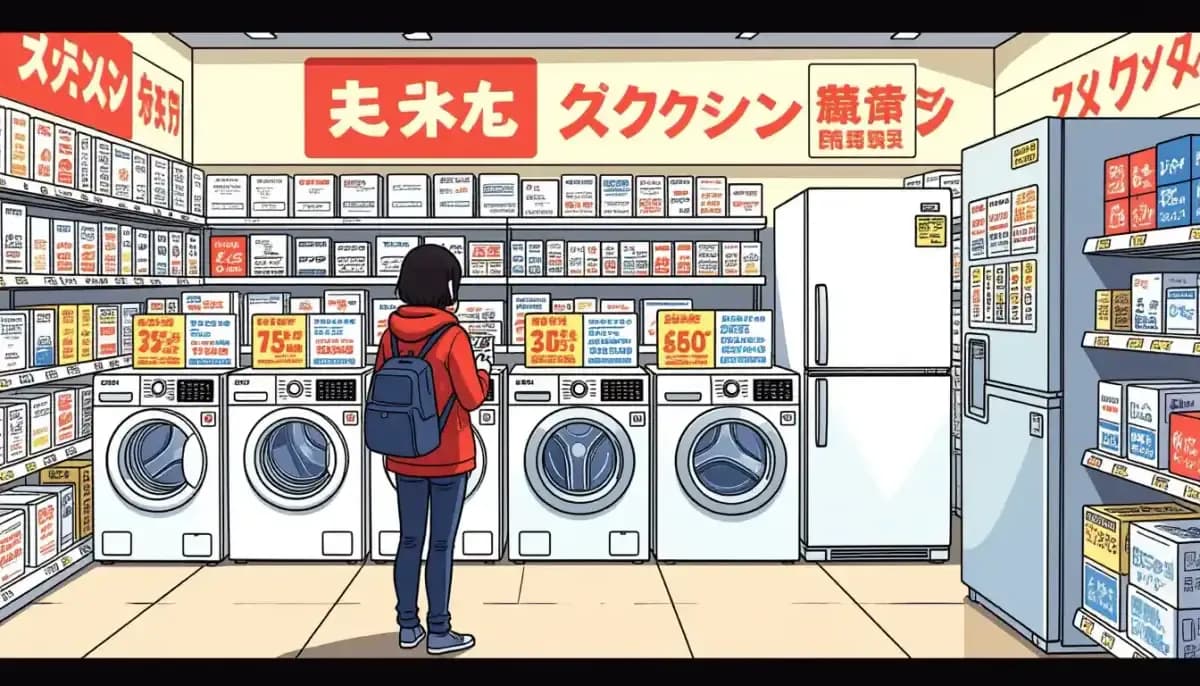
Everything foreigners need to know about buying home appliances in Japan. Learn where to shop, how much to budget, voltage differences, used vs new options, and disposal rules.
Buying Home Appliances in Japan: Complete Guide for Foreigners
Moving to Japan is exciting — but one thing that surprises almost every foreigner is that Japanese apartments come completely empty. No fridge. No washing machine. No curtains. Sometimes not even a ceiling light. Before you can truly settle in, you need to furnish your new home, starting with the essentials.
This guide covers everything you need to know about buying home appliances in Japan as a foreigner: where to shop, what to budget, how to navigate voltage differences, and tips that will save you both time and money.
!Foreigner shopping for home appliances at a Japanese electronics store
Why Japanese Apartments Come Without Appliances
In Japan, landlords follow a strict principle known as genjō-fukki (原状回復), which requires tenants to return the property to its original condition before moving out. Because appliances are considered personal property, landlords do not provide them — and they expect nothing to be left behind either.
This means when you move into a new Japanese apartment, you'll typically need to purchase or rent:
- Refrigerator
- Washing machine (dryers are less common; many Japanese use drying racks)
- Microwave or oven
- Air conditioner (sometimes built-in, sometimes not)
- Ceiling light fixtures
- Curtains or blinds
- Vacuum cleaner
- Rice cooker (highly recommended in Japan)
Budget estimate: Plan on spending ¥100,000 to ¥300,000 for a basic set of appliances when moving into a new Japanese apartment. This can vary widely based on whether you buy new, used, or rent.
Major Electronics Stores in Japan
Japan's large electronics retail chains are the easiest and most foreigner-friendly places to buy appliances. They offer hands-on product demonstrations, delivery services, installation support, and English-speaking staff at some locations.
| Store | Strength | Notable Feature |
|---|---|---|
| Bic Camera (ビックカメラ) | Wide selection, city locations | Point card (ポイントカード) for cashback rewards |
| Yodobashi Camera (ヨドバシカメラ) | Huge flagship stores | Online ordering via yodobashi.com |
| Yamada Denki (ヤマダ電機) | Largest chain in Japan | Often has competitive prices, suburban locations |
| Edion (エディオン) | Strong in Western Japan | Good repair and support services |
| Joshin (上新電機) | Kansai region focus | Budget-friendly options |
Tips for Shopping at Electronics Chains
- Bring your passport — foreign residents can apply for a point card, and it may be required for certain purchases
- Ask about price matching — Japanese stores will often match a competitor's lower price if you show them
- Negotiate — politely asking "Motto yasuku narimasuka?" (もっと安くなりますか?) — "Can you make it cheaper?" — is perfectly acceptable
- Delivery and installation — Delivery fees are separate from the item price; budget ¥1,000–¥5,000 extra per large appliance for delivery and installation
Tax-Free Shopping for Foreigners
If you have recently arrived in Japan (less than 6 months), you may be eligible for tax-free shopping (免税, menzei). This allows you to avoid Japan's 10% consumption tax on qualifying purchases.
Eligibility requirements:
- You must be a short-term visitor or have resided in Japan for less than 6 months
- Minimum purchase: ¥5,000 (excluding tax) per day at the same store
- You must present your passport at the time of purchase
- The items cannot be used in Japan — they must be taken out of the country
Note for long-term residents: If you have a residence card (在留カード, zairyū kādo), you are typically not eligible for tourist tax-free shopping. However, you can still use store point cards and loyalty programs to get discounts.
For more on navigating Japan's shopping system, see our guide to shopping in Japan for foreigners.
Understanding Japan's Unique Electrical Standards
This is critical — Japan's electrical system is different from most of the world, and it affects every appliance you own.
| Specification | Japan (East) | Japan (West) | Most of World |
|---|---|---|---|
| Voltage | 100V | 100V | 110–240V |
| Frequency | 50Hz | 60Hz | 50–60Hz |
| Plug type | Type A (flat 2-pin) | Type A | Varies |
What This Means for You
If you're bringing appliances from abroad:
- Most modern electronics (laptops, phones, cameras) are rated 100–240V and will work in Japan with a plug adapter
- High-powered appliances (hair dryers, electric kettles, rice cookers) are often region-specific and may not work or could be damaged
- Step-up/step-down transformers are available at electronics stores for ¥5,000–¥50,000, but they are heavy and energy-inefficient — usually not worth it for large appliances
East vs. West Japan frequency difference:
- Eastern Japan (Tokyo, Tohoku, Hokkaido): 50Hz
- Western Japan (Osaka, Kyoto, Hiroshima, Fukuoka): 60Hz
- Most modern appliances are compatible with both, but some older appliances (particularly motors in washing machines or fans) may perform slightly differently depending on region
The safest approach: buy appliances in Japan rather than bringing them from abroad. Japanese appliances are designed for Japan's electrical grid, are widely available, and come with local warranty support.
!Japanese home appliances including washing machine and refrigerator
Buying New vs. Used vs. Renting Appliances
Each option has its pros and cons depending on how long you'll be staying in Japan.
| Option | Best For | Estimated Cost | Pros | Cons |
|---|---|---|---|---|
| Buy New | Long-term stays (3+ years) | ¥100,000–¥300,000+ | Full warranty, latest features | High upfront cost |
| Buy Used | Medium stays (1–3 years) | ¥30,000–¥80,000 | Much cheaper, eco-friendly | No warranty, limited selection |
| Rent | Short stays (under 2 years) | ~¥57,750/year for basic set | Low upfront cost, easy disposal | Ongoing monthly cost |
Buying Used Appliances
Japan has an excellent secondhand market. Key places to find used appliances:
- Hard Off / Off House (ハードオフ/オフハウス) — Japan's largest secondhand chain; reliable grading system with clear condition ratings
- Mercari (メルカリ) — Japan's most popular flea market app; huge selection, competitive prices (see our Mercari guide for foreigners)
- Gaijinpot and Facebook Marketplace — Look for "Sayonara Sales" where departing expats sell their entire appliance sets at deep discounts
- Jimoty (ジモティー) — Free local classifieds; sometimes appliances are given away for free if you pick them up
For more secondhand shopping tips, check out our guide to secondhand and thrift shopping in Japan.
Renting Appliances
Renting is an excellent option for foreigners who aren't sure how long they'll stay, or who want to avoid the hassle of appliance disposal when they leave Japan.
Kashite.com (かしてドットコム) is the most well-known appliance rental service in Japan, offering:
- Rental periods from 30 days to 4 years
- Free delivery and setup
- Basic sets including fridge, washing machine, TV, and microwave for approximately ¥57,750/year (~¥158/day)
- No background screening required, making it foreigner-friendly
A basic rental package works out cheaper than buying new if you plan to stay for under two years.
Must-Have Japanese Appliances
Beyond the basics, Japan has some unique appliances that foreigners quickly discover are life-changing. Here's what to consider adding to your home:
Washlet (ウォシュレット)
Japan's famous high-tech toilet seat with bidet function, seat warming, and more. If your apartment doesn't come with one, you can buy standalone washlet seats from ¥15,000. Once you try it, you'll never want to go back.
Rice Cooker (炊飯器, Suihanki)
Even if you don't eat rice regularly, a quality Japanese rice cooker is incredibly versatile — many can cook porridge, bread, soups, and more. Entry-level models start at ¥5,000; high-end models with pressure cooking can exceed ¥50,000.
Drum-Style Washer-Dryer Combo
Many Japanese apartments lack space for a separate dryer, and drying racks are the norm. A washer-dryer combo (洗濯乾燥機) solves this problem but costs more — typically ¥80,000–¥200,000 for a reliable model.
Countertop Dishwasher (食洗機)
Japanese apartments often lack built-in dishwashers, but compact countertop dishwashers have become popular and work well in small spaces. Starting at around ¥30,000.
IH Cooking Range / Induction Hotplate
Many Japanese apartments have IH (electromagnetic induction) cooktops rather than gas. If you're used to gas cooking, expect an adjustment period — and make sure your cookware is IH-compatible.
Online Shopping for Appliances in Japan
Japan's online shopping market is excellent, and buying appliances online is increasingly popular — online sales account for nearly 43% of all appliance purchases in Japan as of 2024.
Top platforms for buying appliances online:
- Amazon Japan (amazon.co.jp) — Fast delivery, English-friendly interface, wide selection
- Yodobashi.com — Free next-day delivery on most items; often matches or beats in-store prices
- Kakaku.com (価格.com) — Japan's premier price comparison site; search any product to find the cheapest current price
- Rakuten Ichiba — Massive marketplace with point rewards; see our Rakuten shopping guide
For a deeper look at online shopping in Japan, see our guide to the best online shopping sites in Japan and our Amazon Japan guide.
Disposing of Old Appliances: Japan's Recycling Law
When the time comes to get rid of large appliances, you cannot simply throw them in the regular garbage. Japan's Home Appliance Recycling Law (家電リサイクル法) requires paid disposal for the following items:
- Air conditioners
- TVs (CRT, plasma, and liquid crystal)
- Refrigerators and freezers
- Washing machines and dryers
How to dispose of large appliances:
- Purchase from a retailer — When buying a new appliance, the store will typically collect the old one for a recycling fee (¥1,000–¥5,000 depending on the item)
- Contact your local municipality — Some cities have specific disposal days or collection services
- Sell or give away — Selling a working appliance on Mercari, Hard Off, or Jimoty is often the easiest solution
- Sayonara Sales — When leaving Japan, sell everything to other expats
Failing to properly dispose of large appliances can result in fines, so make sure to plan ahead when you're leaving your apartment.
Useful Tips for First-Time Appliance Shoppers in Japan
- Measure your space first — Japanese appliances are often smaller than Western equivalents. Bring measurements of your doorways, kitchen alcoves, and installation spaces before shopping
- Check for English menus — Some Japanese appliances lack English interfaces. Ask staff or check the manufacturer's website for English support
- Consider energy efficiency ratings — Japan uses a star-rating system (省エネラベル, shōene raberu) for energy efficiency. Higher-rated appliances cost more upfront but save money on electricity bills
- Check delivery lead times — Major purchases around New Year, spring move-in season (March–April), and summer sales can mean delivery delays of 1–2 weeks
- Warranty registration — Register your appliances with the manufacturer for warranty coverage. Some stores offer extended warranty plans (延長保証) for a small additional fee
Additional Resources
For broader shopping tips and daily life guidance in Japan:
- Living in Nihon: Shopping and Consumer Guide — Comprehensive resource for foreigners navigating Japanese retail
- For Work in Japan: Housing and Living Infrastructure Guide — Practical guide to setting up your life in Japan
- Ittenshoku: Career and Lifestyle Guide — Resources for foreigners building a life in Japan
- Expat.jp: Home Appliances in Japan — Detailed expat guide to appliance shopping
- Plaza Homes: Electronic Appliances Guide — In-depth guide from a Tokyo real estate specialist
Also check our related guides:
- Cost of Living in Japan: What to Expect
- Finding Housing in Japan
- Daily Life in Japan for Foreigners
- 100 Yen Stores in Japan — For budget essentials and small household items
- Furniture Shopping in Japan on a Budget — Complete your home setup

Originally from Vietnam, living in Japan for 16+ years. Graduated from Nagoya University, with 11 years of professional experience at Japanese and international companies. Sharing information about living in Japan for foreigners.
View Profile →Related Articles
Japanese Drug Stores Best Products and Tips
Discover the best Japanese drug store products, top chains like Matsumoto Kiyoshi and Welcia, must-buy skincare and health items, and essential shopping tips for foreigners and expats in Japan.
Read more →
Rakuten Shopping Guide for Foreign Residents in Japan
Complete Rakuten Ichiba guide for foreigners in Japan: how to register, use Rakuten Points, maximize SPU multipliers, navigate sale events, and save money on every purchase.
Read more →
Tax Free Shopping in Japan How It Works for Residents
Complete guide to tax-free shopping in Japan. Learn who qualifies (tourists vs. residents), minimum purchase rules, the 2026 system changes, and how foreign residents can save money without tax-free eligibility.
Read more →
Best Outlet Malls and Discount Stores in Japan
Complete guide to Japan's best outlet malls (Gotemba, Kisarazu, Rinku) and discount stores (Donki, Daiso) for foreigners. Tax-free tips, sale seasons, and practical advice for expats and tourists.
Read more →
Japanese Department Stores Complete Shopping Guide
Complete guide to Japanese department stores (depato) for foreigners: tax-free shopping, floor layouts, depachika food halls, major chains like Isetan and Mitsukoshi, and essential tips for expats.
Read more →
Mercari Japan Buying and Selling Guide for Foreigners
Everything foreigners need to know about using Mercari Japan—creating an account, buying tips, selling strategies, shipping methods, fees, and common pitfalls explained.
Read more →