
Japanese Funeral and Memorial Customs Explained

A complete guide to Japanese funeral and memorial customs for foreigners. Learn about the wake (otsuya), funeral ceremony, koden etiquette, dress code, cremation, kotsuage, and ongoing memorial services including Obon.
Japanese Funeral and Memorial Customs Explained
Attending a Japanese funeral as a foreigner can feel overwhelming. The rituals are deeply rooted in Buddhist tradition, the etiquette is strict, and the cultural expectations differ dramatically from Western practices. Whether you've been invited to a colleague's family funeral or simply want to understand Japanese culture more deeply, this guide walks you through everything you need to know — from the wake to the memorial services held decades later.
Japan has the world's highest cremation rate at 99.94%, and approximately 90% of funerals follow Buddhist ceremonies. Understanding these customs not only helps you avoid cultural missteps but also shows genuine respect for Japanese traditions during one of the most sensitive moments in a family's life.
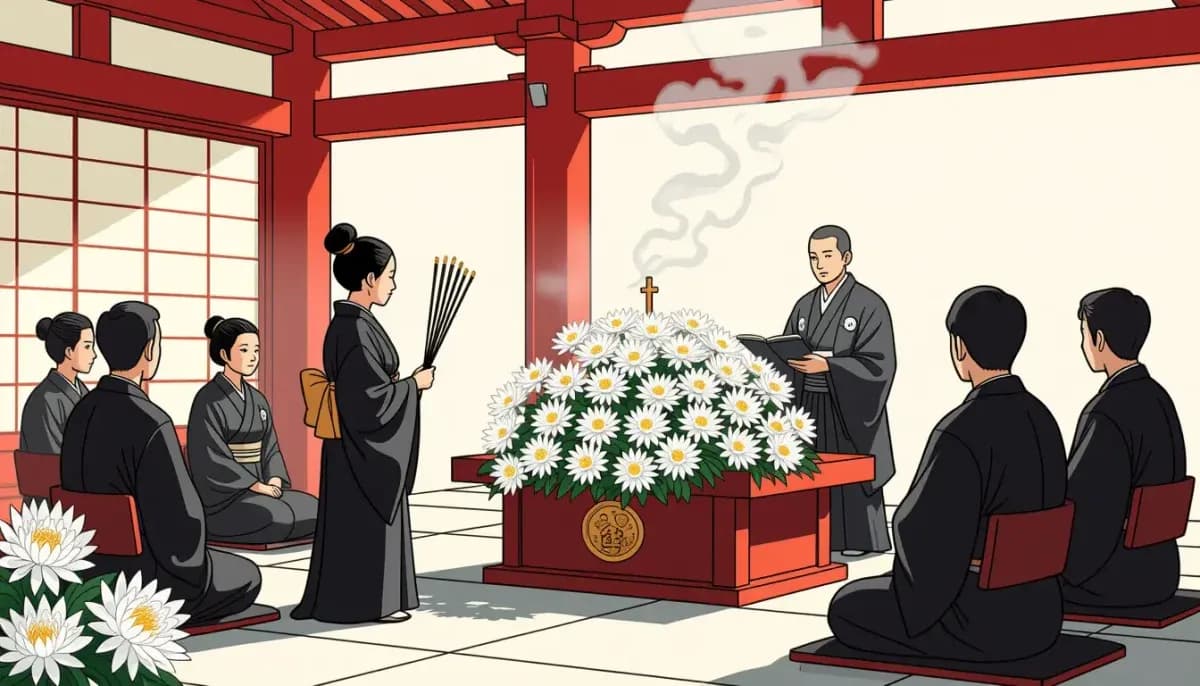
!Japanese funeral altar with white chrysanthemums and incense

The Structure of a Japanese Funeral: From Death to Burial
Japanese funerals follow a relatively consistent sequence of events, though regional and sectarian variations exist. Here is the typical progression:
1. Death Notification and Preparation When someone dies, the family notifies relatives and close friends. A funeral company (葬儀社, sōgisha) is typically contacted immediately to handle logistics. The body is washed, dressed in a white burial kimono (kyōkatabira), and laid out at home or in a funeral hall.
2. Otsuya (お通夜) — The Wake The wake is usually held the evening before the funeral. Traditionally it lasted overnight, but modern wakes typically run for one to three hours. Family, close friends, and sometimes colleagues gather to pay respects, offer incense, and console the bereaved family. Dress code at the otsuya is slightly more relaxed — subdued colors are acceptable since many attendees come straight from work.
3. Ososhiki (お葬式) — The Funeral Ceremony The formal funeral service (also called sougi, 葬儀) is held the following day. A Buddhist priest leads the ceremony with chanting sutras. Attendees offer incense at the altar, and the ceremony concludes with a final farewell before the casket is closed and transported for cremation.
4. Cremation (火葬, kasō) Japan has one of the world's highest cremation rates at 99.94%. After the funeral service, the family accompanies the deceased to the crematorium. Following cremation, the family participates in kotsuage (骨上げ) — a ritual where family members use chopsticks to transfer the bones and ashes into an urn. This is the only occasion in Japanese culture where two people hold the same item simultaneously with chopsticks.
5. Burial and Interment The urn is then typically placed in the family grave (ohaka), often at a Buddhist temple cemetery. This usually happens on the 49th day after death, though practices vary.
Funeral Dress Code: What to Wear
Dress code for Japanese funerals is strict. Wearing the wrong attire can be seen as disrespectful.
| Item | Men | Women |
|---|---|---|
| Top | Black suit, white shirt | Black dress or black suit (knee-length or longer) |
| Tie | Matte black tie | N/A |
| Shoes | Matte black leather (no shiny buckles) | Closed-toe black flat shoes (no reptile skin) |
| Stockings | Black socks | Black opaque tights |
| Jewelry | Wedding ring only | Plain pearl earrings/necklace or wedding ring only |
| Bag | Black or dark | Black or dark, no logos |
Key rules to remember:
- No shiny materials — everything must be matte
- No reptile-skin shoes or bags (snake, crocodile)
- No bright colors or patterns
- Minimal or no perfume/cologne
If you are a foreigner and unsure, err on the side of more formal and more black. Japanese families generally understand that foreigners may not know every detail of the etiquette.
Kōden: Condolence Money Etiquette
One of the most important customs at Japanese funerals is offering kōden (香典) — condolence money. This financial gift helps the family cover funeral expenses and is a deeply ingrained social obligation.
How much to give:
- Acquaintance or coworker: ¥3,000–¥5,000
- Close colleague: ¥5,000–¥10,000
- Close friend: ¥10,000–¥30,000
- Family member: ¥30,000–¥100,000+
Critical rules for kōden:
- Never use crisp, new bills — this implies you anticipated the death and prepared in advance. Use worn bills or crumple new ones slightly.
- Place money in a special kōden envelope (香典袋, kōdenbukuro), available at convenience stores and stationery shops
- Write "御霊前" (Goreizen) on the envelope for Buddhist funerals
- Present it at the reception desk, not directly to the family
- If you attend both the wake and the funeral, offer kōden only once
The family will later send a kōden-gaeshi (香典返し) — a return gift worth roughly half the amount received — usually 30 to 60 days after the funeral.
!Koden envelope and funeral flowers at Japanese funeral

Ritual Behavior During the Ceremony
Incense Offering (焼香, shōkō) This is the central ritual during the funeral ceremony. When it's your turn:
- Walk to the altar and bow once to the deceased's portrait
- Bow to the bereaved family
- Take a small pinch of powdered incense with your right hand (three fingers)
- Hold it briefly at forehead level, then lower it into the incense burner
- Repeat 1–3 times depending on the Buddhist sect
- Bow once more, then step back
Purifying Salt (清め塩, kiyome shio) After leaving the funeral hall, attendees traditionally sprinkle purifying salt on their chest, back, and feet before entering their own homes. Salt packets are often provided by the funeral home. Some modern families skip this practice, but it remains common.
Things NOT to do:
- Do not take photos unless explicitly permitted
- Do not laugh, speak loudly, or use your phone
- Do not cross your chopsticks over food at the post-funeral meal
- Do not pass bones directly from chopstick to chopstick (reserved for the kotsuage ritual)
For a deeper understanding of Japanese social customs and respectful behavior, see our guide on Japanese Culture and Etiquette for Foreigners.
Memorial Services: The 49-Day Period and Beyond
Japanese death rituals don't end with the funeral. A series of memorial services (法要, hōyō) continue for years — sometimes decades — after the death.
Key memorial service dates:
| Service | Japanese Name | When |
|---|---|---|
| 7th day | 初七日 (Shonanoka) | 7 days after death |
| 49th day | 四十九日 (Shijūkunichi) | 49 days after death |
| 100th day | 百か日 (Hyakkanichi) | 100 days after death |
| 1st anniversary | 一周忌 (Isshūki) | 1 year after death |
| 3rd anniversary | 三回忌 (Sankaiki) | 3 years after death |
| 7th anniversary | 七回忌 (Shichikōki) | 7 years after death |
| 13th anniversary | 十三回忌 (Jūsankōki) | 13 years after death |
The 49th day (shijūkunichi) is particularly significant in Buddhist belief — it marks the end of the intermediate state when the soul is believed to reach its final destination. A larger ceremony is typically held, and the ashes are often interred in the family grave at this time.
Memorial services continue on specific anniversaries, sometimes up to the 33rd or 50th year after death, depending on regional and sectarian customs.
Obon: The Festival of the Dead
Obon (お盆) is one of Japan's most important annual events, typically held in mid-August (or mid-July in some regions). During this period, it is believed that the souls of ancestors return to visit the living.
Families observe Obon by:
- Visiting and cleaning family graves (ohaka-mairi, お墓参り)
- Setting up a small altar (shōryōdana) at home with offerings of food, water, and incense
- Lighting mukae-bi (welcome fires) at the entrance of the home to guide spirits in
- Sending off spirits with okuri-bi (farewell fires) at the end of the festival
- Participating in Bon Odori — traditional communal dances at local festivals
For foreigners living in Japan, Obon is a wonderful time to observe Japanese spiritual life. Many workplaces close for several days (the "Obon holiday"), and transportation is extremely busy as people travel to their hometowns.
Learn more about Japanese festivals and seasonal events in our Japanese Festivals and Traditions Guide.
Practical Tips for Foreigners Attending Japanese Funerals
Before you go:
- Confirm whether the service is Buddhist, Shinto, or Christian — each has different customs
- Purchase a kōden envelope at a convenience store (7-Eleven, Lawson, FamilyMart all stock them)
- Bring worn bills in appropriate denominations
- Dress in all matte black from head to toe
At the venue:
- Register your name and address at the reception desk and present your kōden there
- Follow the lead of other attendees during the incense ritual
- Keep your phone on silent and in your pocket
- Offer a brief, sincere condolence to the family: "このたびはご愁傷様でございます" (Kono tabi wa go-shūshō-sama de gozaimasu) — "I am deeply sorry for your loss"
After the funeral:
- Do the salt purification ritual before entering your home
- A written condolence card sent later is appreciated but not mandatory
Cost awareness: The average Japanese funeral costs around 2.31 million yen (approximately $25,000 USD), according to a Japan Consumers Association study. This high cost has led to a growing movement toward simpler "direct funerals" (直葬, chokusō) where the body goes directly to cremation without a formal ceremony.
For more context on costs and financial planning in Japan, see our guide on Cost of Living in Japan.
Resources for Foreigners
Understanding Japanese death customs takes time, and every family and region has slight variations. For further reading and guidance:
- Japan Living Guide — Funeral Etiquette for Expats — Comprehensive guide for foreigners attending Japanese funerals
- Japan Switch — Ultimate Guide to Japanese Funerals — Detailed walkthrough of ceremonies and customs
- Living in Nihon — Religion & Spirituality in Japan — Broader context on Buddhist and Shinto traditions
- For Work in Japan — Family Life Guide — Understanding family obligations and social duties in Japan
- Ittenshoku — Life in Japan Guide — Resources for foreigners navigating daily life in Japan
Japanese funeral customs reflect a profound cultural approach to death, community, and the relationship between the living and the dead. As a foreigner, your effort to understand and respect these traditions — even imperfectly — will be deeply appreciated by Japanese families during their time of grief.

Originally from Vietnam, living in Japan for 16+ years. Graduated from Nagoya University, with 11 years of professional experience at Japanese and international companies. Sharing information about living in Japan for foreigners.
View Profile →Related Articles
Spiritual and Religious Festivals in Japan Guide
Discover Japan's spiritual and religious festivals — from Gion Matsuri to Obon. A complete guide for foreigners on Shinto and Buddhist celebrations, etiquette, and participation tips.
Read more →
Famous Pilgrimage Routes in Japan Guide
Discover Japan's most famous pilgrimage routes including Kumano Kodo, Shikoku Henro, and Dewa Sanzan. A complete guide for foreigners with practical tips, distances, costs, and cultural advice.
Read more →
Jewish Community and Synagogues in Japan
Complete guide to the Jewish community and synagogues in Japan. Find synagogues in Tokyo, Kobe, and Kyoto, kosher food resources, Chabad locations, and tips for Jewish expats and travelers living in Japan.
Read more →
Hindu Temples and Indian Community in Japan
Discover Hindu temples, Little India in Nishi-Kasai, Indian schools, festivals like Diwali, and community resources for Indian expats living in Japan.
Read more →
Religious Freedom and Practice in Japan for Foreigners
Complete guide to religious freedom in Japan for expats. Covers legal rights, Muslim, Christian, Hindu, Jewish communities, halal food, mosques, churches, and workplace accommodation tips.
Read more →
Temple Stay Overnight Experience in Japan Guide
Everything you need to know about temple stays (shukubo) in Japan: where to go, how to book, what to expect, costs, rules, and tips for foreigners experiencing this unique overnight Buddhist experience.
Read more →