
Cycling in Japan Rules Safety and Tips

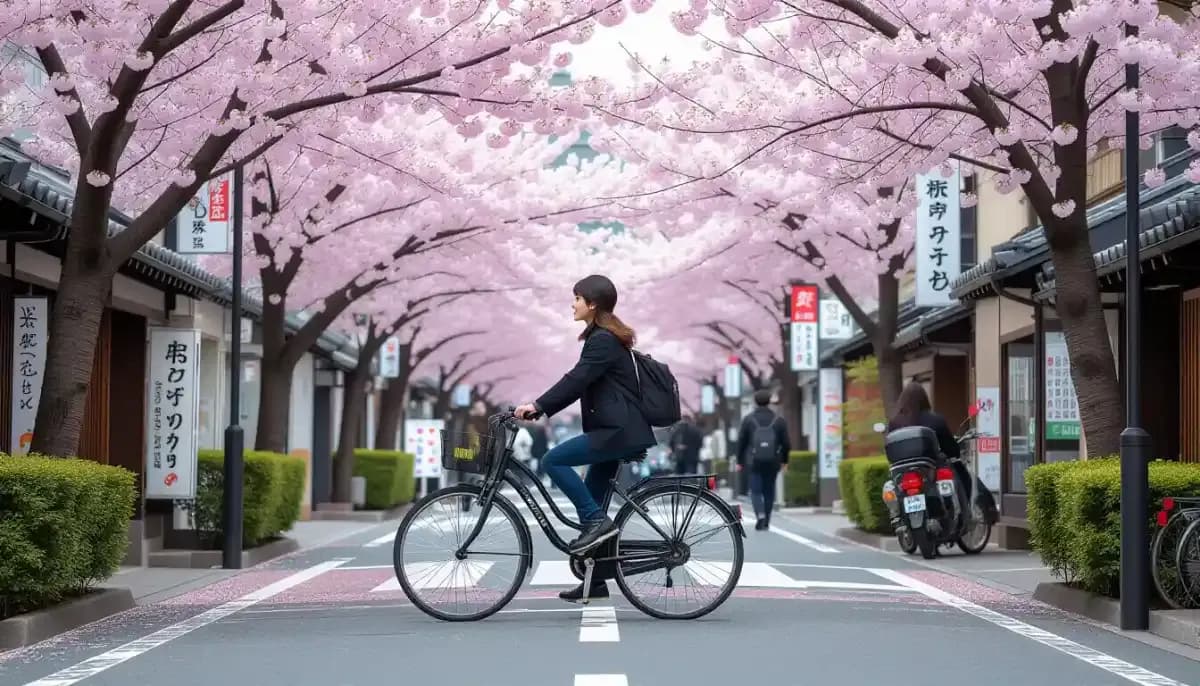
Complete guide to cycling in Japan for foreigners. Learn Japan's bicycle laws, new 2026 blue ticket fines, registration requirements, insurance rules, and essential safety tips for expat cyclists.
Cycling in Japan: Rules, Safety, and Tips for Foreigners
Cycling is one of the most practical and enjoyable ways to get around Japan. Whether you're commuting to work in Tokyo, exploring the backstreets of Kyoto, or touring the countryside, the bicycle is deeply woven into Japanese daily life. But for foreigners, Japan's cycling rules can be surprisingly strict — and as of April 2026, new laws have made enforcement even tighter. This guide covers everything you need to know to cycle safely and legally in Japan.
!Foreigner cycling on a Japanese street with cherry blossoms in the background
Understanding Japan's Bicycle Laws
Bicycles in Japan are classified as vehicles and are subject to the same traffic laws as cars in many respects. This means riding on the left side of the road, obeying traffic signals, and yielding to pedestrians at crosswalks.
Key legal rules:
- Ride on the left side of the road at all times
- Stop completely at red lights and stop signs
- Yield to pedestrians crossing at crosswalks
- Do not ride against traffic (wrong-way cycling is a violation)
- Use hand signals when turning
Sidewalk riding is only permitted in specific situations: for children under 13, adults over 70, or when road conditions make it genuinely dangerous to ride on the road. When allowed on sidewalks, cyclists must keep speed to around 10 km/h and give way to pedestrians at all times.
Hook turns are required at large intersections. Instead of turning right from the right lane (as a car would), you must cross straight through the intersection, stop at the far corner, rotate 90 degrees, and wait for the light to change before proceeding. This keeps cyclists out of fast-moving traffic.
For a broader look at getting around Japan, see our Complete Guide to Transportation in Japan.
New 2026 Cycling Laws: The Blue Ticket System
Starting April 2026, Japan introduced a major crackdown on cycling violations with the "blue ticket system" (青切符制度, ao-kippu seido). Police can now issue on-the-spot fines for 113 different cycling offenses targeting cyclists aged 16 and older.
This is a significant change. Previously, minor violations were often ignored or handled informally. Now, fines are standardized and must be paid within eight days at a post office or bank in cash. Non-payment can result in a court summons and criminal charges.
| Violation | Fine (2026) |
|---|---|
| Riding without a functioning light | ¥5,000 |
| Disregarding a stop sign | ¥5,000 |
| Riding with defective brakes | ¥5,000 |
| Riding against traffic (wrong way) | ¥6,000 |
| Sidewalk cycling where prohibited | ¥6,000 |
| Running a red light | ¥6,000 |
| Carrying a passenger (where prohibited) | ¥3,000 |
| Holding an umbrella while riding | ¥5,000 |
| Listening to music (impairing awareness) | ¥5,000 |
| Using a smartphone while cycling | ¥12,000 |
Motorists also face new obligations — drivers must now maintain a safe distance and appropriate speed when passing cyclists, with fines of ¥5,000–¥9,000 for failure to do so.
Bicycle Registration: Bouhan Touroku
Every bicycle in Japan must be registered with the police through a system called Bouhan Touroku (防犯登録), which translates to "crime prevention registration." This applies to foreigners too.
How to register:
- Buy your bike at a shop — registration is usually handled there automatically
- Pay the registration fee (around ¥660 in Tokyo as of 2024)
- Receive a colored sticker affixed to the bike frame
- Keep your registration certificate in a safe place
If you buy a used bicycle, ask the seller for a "Transfer of Ownership" form. This is essential — police routinely stop cyclists to check ownership, and riding an unregistered bike (or one not transferred properly) can lead to a prolonged encounter at the koban (police box) and suspicion of theft.
If you're new to Japan and navigating legal and administrative processes, our Complete Guide to Daily Life in Japan covers many similar bureaucratic hurdles.
Prohibited Behaviors and Serious Penalties
Some cycling offenses carry criminal penalties, not just fines. Foreigners should be especially aware: a serious violation could affect your visa status.
Drunk cycling is treated harshly in Japan. The penalty can be up to 5 years in prison or a ¥1,000,000 fine. For foreign residents, this could also result in deportation. Even a single conviction can complicate visa renewals.
Smartphone use while cycling is another high-priority offense. Looking at your phone screen or making calls while moving is prohibited (except when fully stopped). Penalties:
- Standard violation: up to 6 months prison or ¥100,000 fine
- If an accident occurs as a result: up to 1 year prison or ¥300,000 fine
- Under the new 2026 blue ticket system: ¥12,000 on-the-spot fine
Other prohibited behaviors:
- Riding with headphones/earphones that impair your hearing (¥50,000 fine)
- Holding an umbrella while riding (¥50,000 fine)
- Side-by-side riding with another cyclist where prohibited (¥20,000 fine)
- Double-riding (carrying a passenger on an adult bike not designed for it)
Japan's cycling accident statistics underline why these laws exist. In 2025, Japan recorded a record-high 3,269 pedestrian-cyclist accidents — up 226 from the prior year. Over 67,000 bicycle-related traffic accidents occurred in 2024, and 75% of all bicycle accidents involved some form of traffic violation by the cyclist.
!Bicycle parking in Japan with neatly arranged bikes and registration stickers
Bicycle Insurance: What You Need to Know
Bicycle liability insurance is legally mandatory in several major prefectures, including Tokyo, Osaka, Kyoto, and Saitama. Even where it isn't legally required, it's strongly recommended — a cycling accident that injures a pedestrian can result in compensation claims of millions of yen.
Insurance typically costs ¥3,000–¥5,000 per year and covers third-party injuries and property damage. Many Japanese home insurance and travel insurance policies include bicycle liability coverage, so check your existing policy first.
You can also purchase standalone bicycle insurance through:
- Japan Post (Kampo)
- Major insurance companies (Tokio Marine, Aioi Nissay Dowa)
- Some bicycle shops offer it at point of sale
- The Japan Bicycle Promotion Institute's affiliated programs
For broader guidance on managing money and insurance in Japan, see our Complete Guide to Banking and Finance in Japan.
Choosing the Right Bicycle in Japan
Japanese bicycles come in several main styles, each suited to different needs:
| Type | Japanese Name | Best For | Approx. Cost |
|---|---|---|---|
| City/commuter bike | Mamachari (ママチャリ) | Daily errands, short commutes | ¥10,000–¥30,000 |
| Sports/cross bike | クロスバイク | Longer commutes, fitness | ¥30,000–¥100,000 |
| Road bike | ロードバイク | Speed, cycling tours | ¥80,000+ |
| E-bike (electric assist) | 電動アシスト自転車 | Hilly areas, longer distances | ¥100,000–¥150,000 |
| Folding bike | 折りたたみ自転車 | Small apartments, trains | ¥20,000–¥80,000 |
The mamachari is by far the most common bicycle in Japan. It features a step-through frame, front basket, ring lock, kickstand, and often a rear child seat. It's practical, affordable, and perfectly suited to Japanese urban life.
Important note on e-bikes from overseas: If you bring or buy an e-bike with a throttle (as opposed to pedal-assist only), it's classified as a motorized vehicle under Japanese law and requires a license plate, driver's license, and insurance. Stick to Japanese-standard e-bikes that activate only when you pedal.
Safety Tips for Cycling in Japan
Japan's cycling infrastructure varies enormously. Tokyo has limited bike lanes compared to cities like Amsterdam, but suburban and rural areas can be excellent for cycling. Here are practical safety tips:
At night:
- A front white light is legally required — not optional
- A rear red reflector is required; a rear light is strongly recommended
- Remove detachable lights when parking to prevent theft
Parking:
- Use designated bicycle parking areas (駐輪場, chūrinjō), which typically cost ¥100–¥200 per session
- Improperly parked bikes are impounded regularly, especially near train stations
- Retrieval fees for impounded bikes run ¥2,000–¥5,000
Theft prevention:
- Always use a lock, even for quick stops (ring locks that attach to the rear wheel are standard on mamachari)
- Use a secondary cable lock for added security
- Register your bike — it significantly improves recovery odds if stolen
- Report theft to police immediately to avoid fees if your bike is found impounded
General road safety:
- Be extremely cautious around buses and large trucks (they turn wide)
- Watch for car doors opening into your path
- Give pedestrians plenty of space — they always have right of way in Japan
- In rain, wet roads and reduced visibility increase accident risk substantially
For more on staying safe in Japan generally, check our Complete Guide to Safety and Emergency Preparedness in Japan.
Cycling Etiquette in Japan
Beyond the law, Japan has strong unwritten cycling norms. Blending in requires understanding these cultural expectations:
- Bell use: Ring your bell only when genuinely necessary to warn pedestrians — constant bell ringing is considered rude
- Speed on sidewalks: Even where cycling on sidewalks is permitted, crawling is expected near pedestrians
- Noise: Shouting, loud music from speakers, or aggressive riding is frowned upon
- Parking manners: Park your bicycle neatly in rows, aligned with others; haphazard parking affects everyone
Japan's cycling culture tends to be quiet, practical, and considerate. The iconic image of the mamachari rider slowly navigating through a neighborhood reflects this ethos perfectly.
Useful Resources
For comprehensive information on living in Japan as a foreigner, including transportation options, visit Living in Nihon's complete transportation guide.
Those working in Japan can find practical commuting advice at For Work in Japan, which covers daily work-life topics for foreign professionals.
IT professionals making the move to Japan may find Ittenshoku useful for career and relocation insights.
For detailed expat-focused cycling rules, Japan Handbook's bicycle guide and the GaijinPot guide to the new 2026 bike laws are excellent references.
Summary
Cycling in Japan is a rewarding and economical way to navigate daily life — but it comes with real legal responsibilities that many foreigners underestimate. Register your bicycle, carry insurance, follow traffic laws, and be especially mindful of the new 2026 enforcement rules. Japan's cycling accident rates are rising, and authorities are responding with stricter enforcement. Ride safely, ride legally, and enjoy everything this cycling-friendly country has to offer.
For a full overview of getting around Japan beyond cycling, see our Complete Guide to Transportation in Japan.

Originally from Vietnam, living in Japan for 16+ years. Graduated from Nagoya University, with 11 years of professional experience at Japanese and international companies. Sharing information about living in Japan for foreigners.
View Profile →Related Articles
Walking and Pedestrian Rules in Japan
Learn all the essential walking and pedestrian rules in Japan — from crosswalk laws and sidewalk etiquette to regional escalator customs and common mistakes foreigners make.
Read more →
Domestic Flights in Japan Budget Tips and Deals
Learn how to find cheap domestic flights in Japan. Compare LCCs like Peach and Jetstar vs JAL/ANA, discover special foreigner fares, and get insider booking tips to save big.
Read more →
Night Bus Travel in Japan Budget Guide
Complete guide to night buses in Japan for foreigners and expats. Prices, routes, booking tips, seat types, and the Japan Bus Pass explained. Save 60-70% vs Shinkansen.
Read more →
Best Transit and Navigation Apps in Japan
Discover the best transit and navigation apps for Japan. From Google Maps and Yahoo Transit to Mobile Suica and GO Taxi, master Japan's train system with the right tools.
Read more →
Japan Commuter Pass Teikiken How to Buy and Use
Everything foreigners need to know about Japan's commuter pass (teikiken): how to buy, cost savings, IC card types, employer reimbursement, and practical tips for daily commuters.
Read more →
Buying a Bicycle in Japan Complete Guide
Everything foreigners need to know about buying, registering, and riding a bicycle in Japan — including mamachari types, costs, registration steps, insurance, and 2026 cycling law updates.
Read more →