
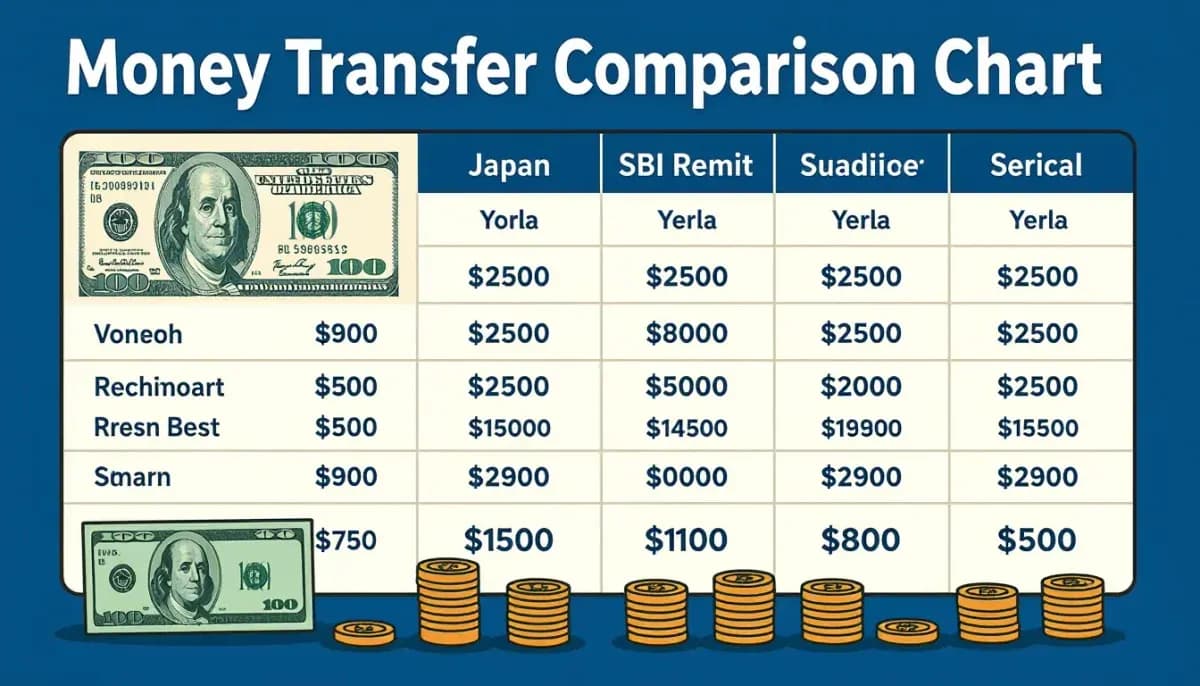
Money Transfer Fees from Japan Complete Comparison
Compare money transfer fees from Japan: Wise, SBI Remit, Revolut, banks and more. Find the cheapest way to send money abroad as a foreigner in Japan with real fee data.
Read more →
Everything foreign residents in Japan need to know about international money transfers: Wise, banks, SBI Remit, fees, documents, and tips to minimize costs.
Sending money from Japan to your home country is one of the most common financial tasks for foreign residents—whether you are supporting family back home, paying off overseas debts, or simply moving savings abroad. The good news is that in 2025 and beyond, there are more options than ever, ranging from traditional banks to cutting-edge fintech apps. The bad news is that the cost differences between services can be dramatic: one wrong choice can cost you thousands of yen in unnecessary fees. This guide covers everything you need to know to send money from Japan efficiently, cheaply, and legally.
Before diving into individual services, it helps to understand the landscape. International money transfers from Japan fall into three main categories:
Each category has trade-offs in fees, exchange rates, speed, and ease of use. For most foreign residents, specialized remittance services offer the best combination of value and convenience.
| Service | Fee (¥10,000 to USD) | Fee (¥100,000 to USD) | Processing Time | Best For |
|---|---|---|---|---|
| Wise | ¥336 | ¥987 | 1–2 business days | Regular senders, best rate |
| Western Union | ¥400 | ¥1,480 | Same day – 2 days | Speed, cash pickup |
| Seven Bank | ¥490 | ¥1,950 | 1–3 business days | Convenience store access |
| PayPal | ~3% | ~3% | Same day – 3 days | Small amounts, convenience |
| Major Banks (SMBC/MUFG) | ¥2,500–4,000 | ¥3,000–7,500 | 3–5 business days | Large business transfers |
| SBI Remit | Varies by country | Varies by country | 1–3 business days | Asia-Pacific countries |
Fee data based on 2025–2026 published rates. Always check current rates before transferring.
Japan takes international money transfers seriously due to anti-money laundering regulations. Before you can send money abroad, you will need to have the following documents ready.
Required for all transfers:
Important: Residency Status Matters
If you have been in Japan for less than 6 months, you are legally classified as a non-resident under Japan's Foreign Exchange and Foreign Trade Act. This means banks may apply additional scrutiny to your transfers and treat even domestic transfers differently. Once 6 months have passed since your arrival, visit your bank and request that your status be changed from non-resident to resident—banks do not do this automatically.
For a full guide on banking in Japan, including how to open an account and manage your finances, see our article on how to open a bank account in Japan as a foreigner.
Wise (formerly TransferWise) has become the go-to choice for foreign residents in Japan who want to send money abroad at the lowest possible cost. The reasons are straightforward:
How to set up Wise in Japan:
Wise is particularly strong for transfers to the US, UK, EU, Australia, and other major currency areas. For specific country comparisons, the Tokyo Cheapo guide publishes regularly updated fee data at tokyocheapo.com.
Japanese major banks—SMBC, MUFG (Bank of Tokyo-Mitsubishi UFJ), Mizuho, and Japan Post Bank—all offer international wire transfers, but they come with significant drawbacks:
Fees: Expect to pay ¥3,000–7,500 per transfer at a branch window, plus a separate foreign exchange margin of 1–3% on top of the mid-market rate.
Speed: Bank wires typically take 3–5 business days.
When banks make sense:
Japan Post Bank Update (2025): Japan Post Bank stopped international remittance services at physical branches on August 29, 2025. However, online international remittance via the Yucho Direct International Remittance platform is still available. If you have relied on Japan Post Bank's branch service, you will need to switch to online or find an alternative provider.
For a comprehensive guide on banking in Japan for foreigners, visit Living in Nihon's banking guide.
If you are sending money to countries in Asia—particularly the Philippines, Vietnam, Bangladesh, Nepal, Malaysia, Indonesia, or Sri Lanka—several specialized services offer excellent rates and country-specific features:
SBI Remit: Operated by SBI Group, SBI Remit offers competitive rates to many Asian countries. They support cash pickup options through partner networks, which is useful for recipients who do not have bank accounts. SBI Remit is particularly popular for transfers to the Philippines (via GCash) and Southeast Asia.
Japan Remit Finance (JRF): Specializes in transfers to specific countries with competitive flat-fee structures.
Brastel: Well-known in the Brazilian-Japanese community and for transfers to Latin America.
Japan Money Express: Serves remittances to a range of Asian countries with competitive rates.
Note that GoRemit, which was previously operated by SBI Shinsei Bank and was popular with English-speaking expats, was discontinued in October 2025. If you were using GoRemit, you will need to switch to an alternative service such as Wise or SBI Remit.
For career and job-related financial planning as an expat in Japan, For Work in Japan offers guidance on navigating your career and income in Japan.
Western Union is available at 15+ branches in Tokyo and at Lawson convenience stores nationwide. It charges ¥400 for a ¥10,000 transfer and ¥1,480 for ¥100,000 to USD—slightly more than Wise, but it offers same-day transfers to cash pickup locations, which is useful when your recipient needs cash immediately or does not have a bank account.
Seven Bank (the bank associated with 7-Eleven) is another convenient option, with ATMs available 24/7 across Japan. Fees are ¥490 for ¥10,000 and ¥1,950 for ¥100,000 to USD. Seven Bank requires advance registration and My Number verification before you can send international transfers.
Both services are more expensive than Wise for regular bank-to-bank transfers, but their convenience factor is real—especially at midnight or on weekends when you need to send money quickly.
For resources on IT career transitions and working in Japan, Ittenshoku provides guides for foreign workers navigating the Japanese job market.
Sending money smartly can save you significant amounts over a year of regular transfers. Here are the most effective strategies:
1. Compare exchange rates, not just fees: A service that charges zero fees but uses a poor exchange rate can cost you more than a service with transparent fees and mid-market rates. Always calculate the total amount your recipient will receive.
2. Bundle your transfers: Instead of sending small amounts frequently, consider sending larger amounts less often. Most services have a fixed component to their fees, so larger transfers are proportionally cheaper.
3. Use the right service for the right currency: Wise is best for most major currencies (USD, EUR, GBP, AUD). For certain Asian currencies and cash pickups, regional services like SBI Remit may offer better deals.
4. Check for promotions: Many services offer fee-free first transfers or special promotional rates. Wise occasionally runs promotions for new users.
5. Set up rate alerts: Some services allow you to set a target exchange rate and will notify you when the rate is favorable. This is particularly useful for large transfers.
6. Avoid PayPal for large amounts: PayPal's 3–4% conversion charge becomes very expensive on larger transfers. It is only practical for small convenience transfers.
Understanding your overall cost of living in Japan helps you plan how much to send home. See our cost of living in Tokyo breakdown for a detailed look at monthly expenses.
Japan has reporting requirements for large international transfers. Here are the key points every foreign resident should know:
For a comprehensive understanding of your Japanese tax obligations, see our Japan income tax guide for foreign residents.
Always consult with a tax professional (税理士 / zeirishi) if you have complex cross-border financial arrangements.
If this is your first time sending money internationally from Japan, here is a straightforward walkthrough using Wise as an example:
Most transfers to major currencies complete within 24–48 hours. Keep the transfer confirmation for your records. For a detailed comparison of fees and services updated in 2026, Japan Life Start has a useful fee comparison guide for Wise, SBI Remit, Revolut, and bank transfers.
For setting up all your services when first arriving in Japan, our guide on how to set up utilities in your Japan apartment has you covered.
Sending money from Japan does not have to be complicated or expensive. Here is a quick summary of the best choices for different situations:
With your My Number Card ready, an account at a good Japanese bank, and access to Wise or another quality remittance service, you can send money home quickly and affordably. For more guidance on managing your finances as a foreigner in Japan, check our full guide to moving to Japan and our Japan national health insurance guide to ensure all your financial bases are covered.
Compare money transfer fees from Japan: Wise, SBI Remit, Revolut, banks and more. Find the cheapest way to send money abroad as a foreigner in Japan with real fee data.
Read more →
Complete guide to GoRemit Shinsei Bank's international transfer service, its October 2025 discontinuation, and the best alternatives for expats in Japan including SBI Remit and Wise.
Read more →
Practical tips for foreigners sending money to family from Japan. Compare Wise, bank transfers, SBI Remit. Save on fees, time transfers, claim tax deductions for overseas dependents.
Read more →
Complete guide to SBI Remit for foreigners in Japan. Learn how to register, compare fees by country (Philippines, Vietnam, China), transfer methods, and tips to save money on international transfers.
Read more →
Understand Japan's remittance tax rules for non-permanent residents: the ¥1,000,000 reporting threshold, deemed remittance rules, FX gains, and how to file correctly as a foreigner in Japan.
Read more →
Learn how to use cryptocurrency for international remittances from Japan. Compare XRP, Bitcoin, and stablecoins, understand tax rules, and discover the best FSA-licensed exchanges for foreign residents.
Read more →
Complete guide to using PayPal in Japan as a foreigner. Learn how to set up your account, link Japanese bank accounts, understand fees, and discover the best PayPal alternatives for expats in Japan.
Read more →
Complete guide to using Western Union in Japan for foreigners. Learn about fees, ID requirements, Seven Bank ATMs, FamilyMart locations, and step-by-step sending instructions.
Read more →
Complete guide to using Revolut in Japan as a foreign resident. Learn about plans, fees, ATM access, currency exchange, limitations, and how Revolut compares to Japanese banks.
Read more →
Learn how to do a bank wire transfer from Japan step by step. Compare fees at MUFG, Mizuho, Japan Post Bank, and GoRemit. Includes domestic furikomi and international SWIFT transfer guides for foreigners.
Read more →
Complete guide to Japan Post Bank international money transfers for foreigners in Japan. Learn fees, limits, step-by-step process, and compare with Wise and other alternatives in 2025.
Read more →
A complete guide to setting up and using Wise in Japan. Learn verification requirements, step-by-step transfer process, fee comparisons, and tips for foreigners sending money internationally from Japan.
Read more →
Compare the best ways to send money from Japan in 2026. Wise, SBI Remit, Revolut, and traditional banks compared by fees, exchange rates, and speed for foreigners and expats.
Read more →
Compare the top money transfer services in Japan including Wise, SBI Remit, Western Union, and Revolut. Find the cheapest and fastest option for sending money abroad as a foreigner in Japan.
Read more →