
Money Transfer Fees from Japan Complete Comparison

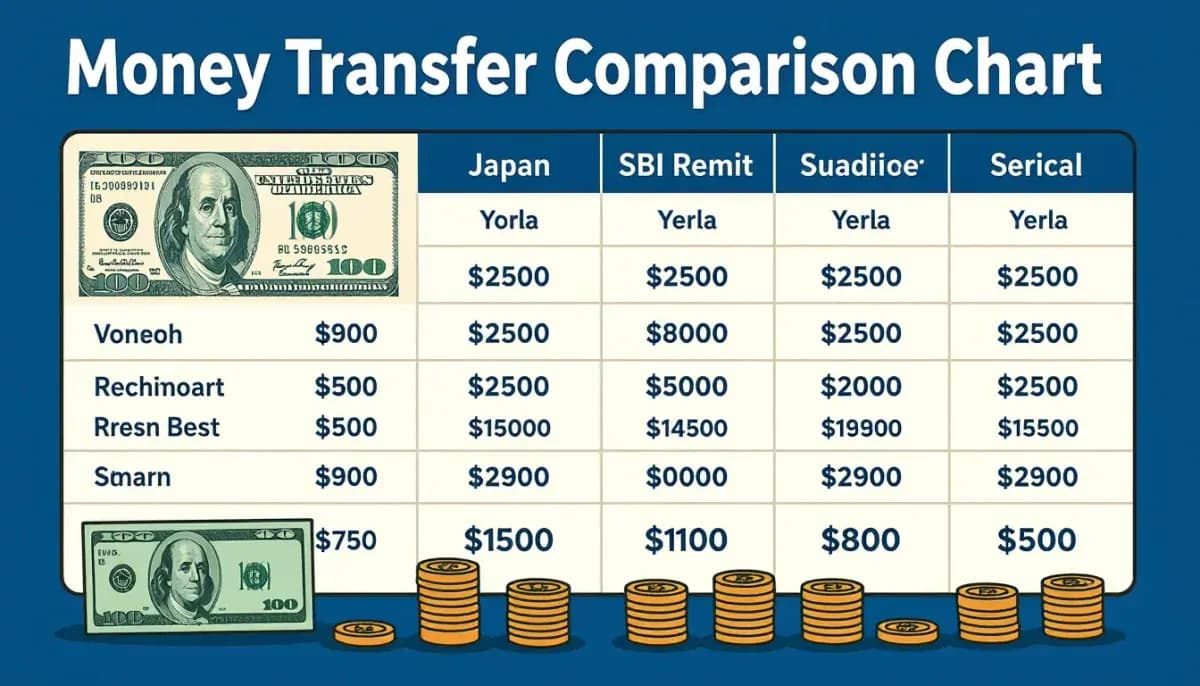
Compare money transfer fees from Japan: Wise, SBI Remit, Revolut, banks and more. Find the cheapest way to send money abroad as a foreigner in Japan with real fee data.
Money Transfer Fees from Japan: Complete Comparison Guide
Sending money from Japan to your home country is something most expats and foreign workers need to do regularly. Whether you're supporting family back home, paying off a loan, or simply moving savings — the fees and exchange rates can make a huge difference in how much actually arrives. This guide breaks down the complete comparison of money transfer fees from Japan, so you can make the smartest choice every time.
Why Money Transfer Fees Matter More Than You Think
The cost of sending money abroad from Japan goes beyond the stated transfer fee. Banks and some services advertise "zero transfer fees" while quietly adding a markup to the exchange rate — sometimes 1 yen or more per dollar. That hidden cost can add up fast.
For example, if you send 1,000,000 JPY through a traditional Japanese bank, you could lose approximately 6,600 JPY just from the exchange rate markup alone — before any stated transfer fee. Over a year of regular remittances, this could amount to tens of thousands of yen in unnecessary costs.
There are two types of costs to watch:
- Transfer Fee — The flat or percentage fee charged per transaction
- Exchange Rate Markup — The difference between the mid-market rate and what the service offers you
The best services keep both low. The worst services advertise one being zero while hiding costs in the other.
Complete Fee Comparison: Top Money Transfer Services from Japan
Here is a detailed breakdown of the major services available for sending money overseas from Japan in 2026:
| Service | Transfer Fee (¥100,000) | Exchange Rate | Speed | Best For |
|---|---|---|---|---|
| Wise | ~987 JPY | Mid-market (0 markup) | 1–4 days | Most transfers |
| Western Union | ~1,480 JPY | Slight markup | 1–3 days | Cash pickup |
| Seven Bank | ~1,950 JPY | Markup applies | 1–3 days | ATM convenience |
| SBI Remit | ~1,980 JPY | Slight markup | 1–2 days | Philippines, Vietnam |
| Sony Bank | ~3,000 JPY | Competitive for large | 2–3 days | 1M+ JPY transfers |
| Japan Post Bank | 3,000–7,500 JPY | Markup applies | 3–5 days | In-person support |
| Traditional Banks | 5,500+ JPY | 1+ yen/dollar markup | 3–7 days | None (costly) |
| PayPal | Variable | 3–4% markup | Instant | Small amounts only |
| Revolut | Free (weekdays) | Mid-market (weekdays) | 1–3 days | Frequent senders |
Data based on February 2026 rates. Always check current rates before transferring.
For a real-world test: sending ¥100,000 to USD using Wise delivers approximately $636.90 USD, while Western Union delivers $627.39, and traditional banks deliver as little as $608.96 — a difference of nearly $28 USD on a single transfer.
Wise: The Top Choice for Most Foreigners in Japan
Wise (formerly TransferWise) consistently ranks as the best option for most expats sending money from Japan. Here's why:
- Mid-market exchange rate — No hidden markup, you get the real rate
- Low, transparent fees — Starting around 0.43%, clearly shown before you confirm
- High transfer limits — Send up to ¥150,000,000 per transfer
- Fast delivery — Typically 1–4 days, often same day or next day
- Simple verification — Requires your My Number Card (or My Number Notification Card + photo ID)
The main downside: Wise is not ideal for recipients who need cash pickup. For that, services like Western Union or SBI Remit are better options.
For more information on managing your finances in Japan, check out our Complete Guide to Banking and Finance in Japan for Foreigners.
SBI Remit: Best for Sending to Asia
SBI Remit is a Japanese remittance service popular with foreign workers sending money to Southeast Asia, particularly the Philippines and Vietnam. Key features:
- Cash pickup option — Recipients can pick up cash at partner locations without a bank account
- Competitive rates for Asia routes — Lower costs for certain corridors
- Transfer fee around 1,980 JPY for ¥100,000
- Fast processing — Often 1–2 business days
The trade-off is slightly higher fees compared to Wise for standard bank-to-bank transfers. But for families without bank accounts, the cash pickup option is invaluable.
See Living in Nihon's Banking and Financial Services Guide for Foreigners for broader financial tips for expats in Japan.
Revolut: Great for Regular Senders (With One Catch)
Revolut offers excellent rates for frequent senders with its mid-market exchange rate — but there's an important caveat:
- Weekday transfers: Free exchange up to 750,000 JPY/month at mid-market rate
- Weekend surcharge: A 1% fee is added for all currency exchanges on Saturdays and Sundays
- Monthly limit: After 750,000 JPY free, standard fees apply
If you're a regular sender, timing your transfers for weekdays with Revolut can save significant money. But if you often transfer on weekends, Wise may be more predictable.
For general guidance on working and earning in Japan, see our Complete Guide to Working in Japan as a Foreigner.
Traditional Japanese Banks: What to Avoid
Japan's major banks (MUFG, SMBC, Mizuho) and Japan Post Bank charge some of the highest fees for international transfers:
- Japan Post Bank: ¥3,000 online / ¥7,500 at the counter + ¥2,500–3,000 intermediary bank fee
- Major city banks: ¥4,000–¥5,500 per transfer + exchange rate markup
- Exchange rate markup: Often 1+ yen per dollar, adding hidden costs on top of stated fees
- SWIFT intermediary fees: When using bank wire transfers, multiple correspondent banks may deduct fees from the transferred amount
The biggest problem is the combination of high stated fees AND hidden exchange rate markups. For a ¥100,000 transfer, you might receive $608.96 USD through a bank versus $636.90 through Wise — a gap that compounds significantly with larger amounts.
If you're still setting up finances in Japan, our Complete Guide to Cost of Living in Japan can help you plan your budget effectively.
Services No Longer Available
GoRemit — formerly one of the most popular services among English-speaking expats in Japan — was discontinued in October 2025. If you were using GoRemit, you need to switch to an alternative like Wise, Revolut, or SBI Remit.
PayPal continues to be available but is not recommended for large transfers due to its 3–4% currency conversion fee and lack of transparency on exact exchange rates. It works for small amounts where convenience matters more than cost.
How to Choose the Right Service
Use this decision guide to pick the best service for your situation:
- Standard bank-to-bank transfer → Wise (best rates, transparent fees)
- Sending to Philippines or Vietnam → SBI Remit (cash pickup available)
- Frequent transfers on weekdays → Revolut (free exchange up to 750K JPY/month)
- Large transfer over 1M JPY → Sony Bank or Wise (check current rates)
- In-person support needed → Japan Post Bank (higher cost, but accessible)
- Recipient needs cash pickup → Western Union or SBI Remit
For more resources on living as a foreigner in Japan, For Work in Japan (forworkinjapan.com) offers comprehensive guides on finances and working life.
Documents Required for International Transfers from Japan
Regardless of which service you use, you'll typically need:
- My Number Card (Individual Number Card) — the most widely accepted form of ID for fintech services
- Or: My Number Notification Card + a photo ID (passport, residence card)
- Residence Card (在留カード) — to confirm your legal status in Japan
- Bank account details — recipient's IBAN, SWIFT/BIC code, and bank address
- Source of funds — for large transfers, some services ask about the origin of funds
Wise in Japan specifically requires My Number verification for compliance with Japanese regulations.
Tips to Minimize Transfer Costs
- Compare rates on the day you transfer — exchange rates fluctuate; even a small difference matters
- Avoid weekend transfers on Revolut to skip the 1% surcharge
- Batch smaller transfers into larger ones — some services charge flat fees, so consolidating saves money
- Check for promotional rates — Wise and other services occasionally offer fee discounts for new users
- Use mid-market rate as your benchmark — check Google or XE.com to see the real rate before comparing services
- Never use your bank for regular remittances — the fee difference can total hundreds of dollars per year
For comprehensive advice on financial planning during your Japan life, Ittenshoku (ittenshoku.com) provides resources for understanding financial responsibilities.
Conclusion: Save Thousands by Choosing Wisely
The difference between a good and bad money transfer service from Japan is not trivial. Over a year of monthly transfers, choosing Wise or Revolut over a traditional bank can save you the equivalent of ¥50,000–¥100,000 or more, depending on your transfer amounts.
The key takeaways:
- Wise is the best default choice for most foreigners in Japan
- SBI Remit wins for cash pickup in Southeast Asia
- Revolut is great for frequent weekday transfers
- Traditional banks should be your last resort — not your first
- GoRemit is gone as of October 2025 — switch to an alternative now
For more expat financial guidance, explore our complete resources on banking and finance in Japan and daily life in Japan for foreigners.
Additional resources:

Originally from Vietnam, living in Japan for 16+ years. Graduated from Nagoya University, with 11 years of professional experience at Japanese and international companies. Sharing information about living in Japan for foreigners.
View Profile →Related Articles

GoRemit Shinsei Bank International Transfer Guide
Complete guide to GoRemit Shinsei Bank's international transfer service, its October 2025 discontinuation, and the best alternatives for expats in Japan including SBI Remit and Wise.
Read more →
Tips for Sending Money to Family from Japan
Practical tips for foreigners sending money to family from Japan. Compare Wise, bank transfers, SBI Remit. Save on fees, time transfers, claim tax deductions for overseas dependents.
Read more →
SBI Remit Japan International Transfer Guide
Complete guide to SBI Remit for foreigners in Japan. Learn how to register, compare fees by country (Philippines, Vietnam, China), transfer methods, and tips to save money on international transfers.
Read more →
Comparing Money Transfer Services Available in Japan
Compare the top money transfer services in Japan including Wise, SBI Remit, Western Union, and Revolut. Find the cheapest and fastest option for sending money abroad as a foreigner in Japan.
Read more →
Japan Remittance Tax Rules and Reporting Requirements
Understand Japan's remittance tax rules for non-permanent residents: the ¥1,000,000 reporting threshold, deemed remittance rules, FX gains, and how to file correctly as a foreigner in Japan.
Read more →
Cryptocurrency for Remittances from Japan
Learn how to use cryptocurrency for international remittances from Japan. Compare XRP, Bitcoin, and stablecoins, understand tax rules, and discover the best FSA-licensed exchanges for foreign residents.
Read more →