
Japanese Clothing Sizes Conversion Guide for Foreigners

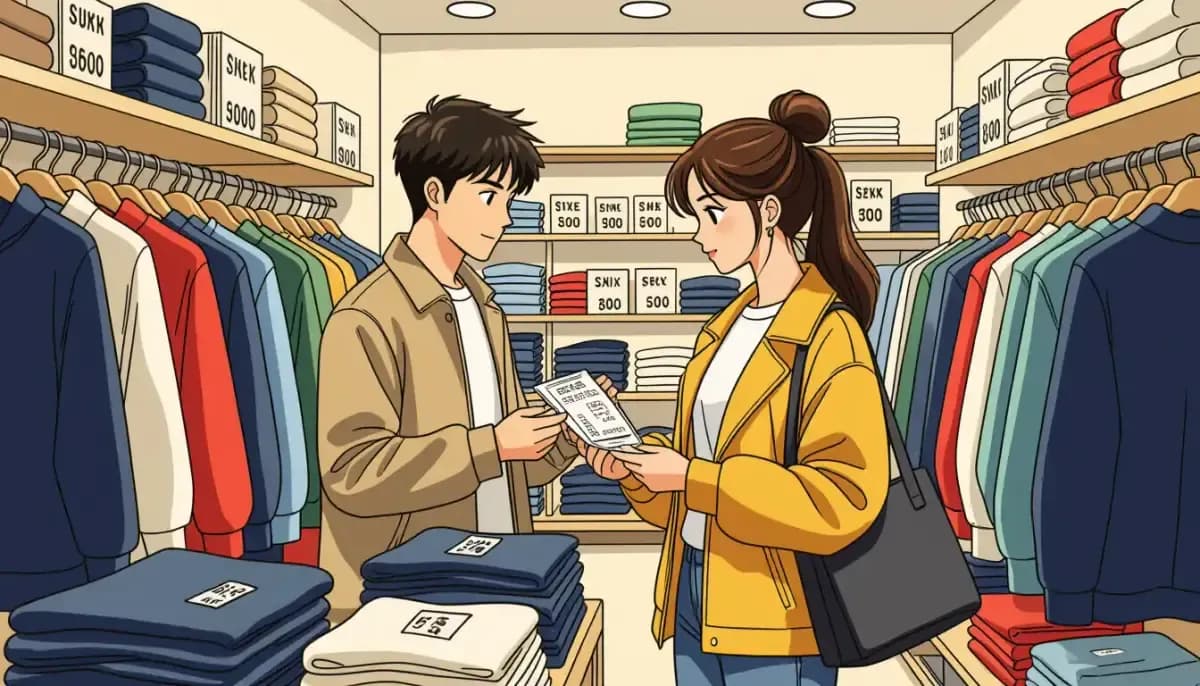
Complete Japanese clothing size conversion guide for foreigners and expats. Women, men, shoes, bra sizes with conversion tables. Tips for finding larger sizes in Japan.
Japanese Clothing Sizes Conversion Guide for Foreigners
Shopping for clothes in Japan can be a surprisingly confusing experience for foreigners. Japanese sizing standards differ significantly from Western measurements, and what fits perfectly at home may not even go on in a Japanese store. Whether you're visiting Japan for a week or settling in as a long-term expat, understanding the Japanese clothing size system is essential for stress-free shopping.
This guide breaks down everything you need to know about Japanese clothing sizes — from women's and men's conversions to shoes, bras, and children's clothing — plus practical tips for finding clothes that actually fit your body.
!A foreigner looking at clothing size charts in a Japanese store

Why Japanese Clothing Sizes Run Smaller
The fundamental reason Japanese clothing runs smaller than Western sizes comes down to body proportions. The average Japanese man stands at 171 cm (5'7") and weighs around 62 kg, while the average Japanese woman is 158 cm (5'2") and weighs around 50 kg. In contrast, the average American man is about 177 cm (5'10") and the average American woman is 163 cm (5'4").
Japanese clothing manufacturers design their garments to fit the average Japanese body, which means foreigners — especially those from North America, Europe, or Australia — will often need to size up significantly. According to the Japan Fashion Association, approximately 67% of foreign shoppers struggle with Japanese sizing when they first arrive.
The issue isn't just height. Japanese cuts tend to be narrower through the shoulders, hips, and chest. Even if your length fits, the width may be too narrow. This is especially common for people with broader shoulders or curvier body shapes.
Women's Clothing Size Conversion
Women's clothing sizes in Japan use a numeric system that differs from both US and UK sizing. As a general rule, US sizes are approximately 5 sizes larger than Japanese sizes.
| Japanese Size | US Size | UK Size | EU Size | Bust (cm) | Waist (cm) | Hip (cm) |
|---|---|---|---|---|---|---|
| 5 (XS) | 0-2 | 4-6 | 32-34 | 76-79 | 58-61 | 82-85 |
| 7 (S) | 2-4 | 6-8 | 34-36 | 79-82 | 61-64 | 85-88 |
| 9 (M) | 4-6 | 8-10 | 36-38 | 82-86 | 64-67 | 88-92 |
| 11 (L) | 8-10 | 10-12 | 38-40 | 86-90 | 67-70 | 92-96 |
| 13 (XL) | 10-12 | 12-14 | 40-42 | 90-94 | 70-74 | 96-100 |
| 15 (XXL) | 12-14 | 14-16 | 42-44 | 94-98 | 74-78 | 100-104 |
| 17 (3XL) | 14-16 | 16-18 | 44-46 | 98-103 | 78-83 | 104-109 |
For UK sizes, the conversion is simpler: add 1 to the UK size to get the Japanese size (UK 8 = Japanese 9, UK 10 = Japanese 11).
Important note about "Free Size": Many Japanese garments are labeled "Free Size" (フリーサイズ), which typically fits Japanese women around 158 cm. If you're taller or have a larger frame, "Free Size" items may be too short, too narrow, or just generally ill-fitting.
For more general shopping advice in Japan, check out our Complete Guide to Shopping in Japan for Foreigners.
Men's Clothing Size Conversion
Men's clothing in Japan uses a mix of lettered sizes (S, M, L, XL, LL, 3L) and numeric sizes. The key thing to remember is that Japanese S corresponds roughly to Western XS, and Japanese sizes run about one to two sizes smaller overall.
Dress Shirts (collar size in cm):
| US/UK Size | Japanese Size |
|---|---|
| 14 inch | 36 |
| 14.5 inch | 37 |
| 15 inch | 38 |
| 15.5 inch | 39 |
| 16 inch | 40 |
| 16.5 inch | 41 |
General Men's Clothing:
| Japanese | US | UK | Chest (cm) |
|---|---|---|---|
| S | XS | XS | 82-86 |
| M | S | S | 86-90 |
| L | M | M | 90-94 |
| XL/LL | L | L | 94-98 |
| 2L/3L | XL | XL | 98-106 |
| 4L | XXL | XXL | 106-114 |
Pants: Japanese men's pants are typically sized by waist measurement in centimeters. To convert your waist size: multiply inches by 2.54 (e.g., 32 inch waist = 81 cm).
For context on adjusting to daily life as a foreigner in Japan, you might also want to read our Complete Guide to Daily Life in Japan for Foreigners.
Shoe Size Conversion for Japan
Japanese shoe sizes are measured in centimeters (the length of your foot), which is actually a very logical system once you get used to it. Simply measure your foot length in centimeters and that's your Japanese shoe size.
| JP Size (cm) | US Women | US Men | UK Women | UK Men | EU |
|---|---|---|---|---|---|
| 22.0 | 5 | — | 2.5 | — | 34-35 |
| 23.0 | 6 | — | 3.5 | 5 | 36-37 |
| 24.0 | 7.5 | 6 | 5 | 5.5 | 38 |
| 25.0 | 8.5 | 7 | 6 | 6.5 | 39-40 |
| 26.0 | 9.5 | 8 | 7.5 | 7.5 | 41 |
| 27.0 | 10.5 | 9 | 8.5 | 8.5 | 42-43 |
| 28.0 | — | 10 | — | 9.5 | 43-44 |
| 29.0 | — | 11 | — | 10.5 | 44-45 |
The big challenge: Japanese shoe stores typically stock women's shoes up to around 25 cm (US 8.5) and men's shoes up to 27-28 cm (US 9-10). If you wear larger sizes, you'll need to shop at specialty stores or online.
For men's larger shoe sizes, Sakazen and specialty Big and Tall retailers carry wider selections. Zozotown's Zozomat feature also allows you to scan your feet with a smartphone for precise measurements before ordering online.
Bra Size Conversion in Japan
Bra sizing in Japan differs considerably from Western systems, and this is one area where many foreign women find the transition particularly confusing.
Band Size Conversion:
| US/UK Band | Japanese Band |
|---|---|
| 30 | 65 |
| 32 | 70 |
| 34 | 75 |
| 36 | 80 |
| 38 | 85 |
| 40 | 90 |
Japanese band sizes increase in multiples of 5 cm, while US/UK sizes increase in 2-inch increments.
Cup Size: Japanese cup sizes follow a similar lettered system (A, B, C, D, E, F, G), but the cups tend to run smaller. As a general rule, size up one to two cup sizes when buying Japanese bras. For example, a US 34B would typically correspond to a Japanese 75C or 75D.
Also note that Japanese bras rarely come in sizes larger than E or F cups in regular stores. For larger cup sizes, specialty lingerie stores or online shopping is your best option.
!Japanese clothing size chart comparison showing US EU and Japanese sizes

Children's Clothing Sizes in Japan
Japanese children's clothing uses a highly practical system: sizes are based on height in centimeters. This makes it easy to find the right size without worrying about age-based sizing, which can vary significantly between brands.
| Japanese Size (cm) | Age (approximate) | Height Range |
|---|---|---|
| 60 | 0-3 months | 55-65 cm |
| 70 | 3-6 months | 65-75 cm |
| 80 | 6-12 months | 75-85 cm |
| 90 | 1-2 years | 85-95 cm |
| 100 | 2-3 years | 95-105 cm |
| 110 | 3-5 years | 105-115 cm |
| 120 | 5-7 years | 115-125 cm |
| 130 | 7-9 years | 125-135 cm |
| 140 | 9-11 years | 135-145 cm |
| 150 | 11-13 years | 145-155 cm |
| 160 | 13-15 years | 155-165 cm |
Children's sizing is generally more forgiving than adult sizing in terms of fit variations. For guidance on raising children in Japan, our Complete Guide to Raising Children in Japan covers education, healthcare, and everyday life.
Where to Find Larger Sizes in Japan
One of the most common frustrations for foreigners in Japan is finding clothing in larger sizes. The good news is that options have improved significantly in recent years.
Specialty Stores for Larger Sizes:
- Sakazen — One of the best options for men's Big and Tall clothing, carrying sizes up to 9L. Located mainly in Tokyo.
- Punyus — Trendy women's fashion in sizes up to 6L (approximately US size 22-24). Founded by comedian Watanabe Naomi.
- Shimamura — Budget-friendly nationwide chain with dedicated plus-size sections.
- AEON — Large supermarket/mall chain with plus-size sections in women's and men's departments.
Western Brands That Use Western Sizing:
- H&M — Generally stocks Western-equivalent sizing; an M in H&M Japan feels like an M in Europe.
- Gap — Carries Western-style sizing in stores and online.
- Zara — European sizing, generally runs larger than Japanese brands.
- Uniqlo — While a Japanese brand, Uniqlo has expanded its size range significantly online (XL through 4XL available on their website with in-store pickup).
Online Shopping: Online shopping provides the widest size selection in Japan. Zozotown is Japan's largest fashion e-commerce platform and carries thousands of brands with detailed size charts. Rakuten Fashion and Amazon Japan also have extensive selections.
For a deeper dive into navigating Japanese retail, Clothes Shopping in Japan as a Foreigner from Interac is an excellent resource, and Clothes and Shoes Shopping in Japan from Japan Handbook provides great practical tips.
Practical Tips for Shopping in Japan
Before you go shopping:
- Measure yourself in centimeters (height, chest/bust, waist, hips, inseam, foot length)
- Write these measurements down or save them in your phone
- Know your measurements for multiple size systems to help staff assist you
While shopping:
- Always try things on when possible — Japanese sizes can vary significantly by brand
- Japanese staff are usually very helpful; show them your measurements if you're unsure
- When staff offer a face cover before trying on tops, this is standard hygiene practice — accept it
- Remove shoes before entering fitting room areas (this is standard etiquette)
- "Free Size" items are designed for average Japanese body types; approach with caution
For taller individuals:
- Look specifically for brands offering Tall or Long variations online
- Department stores like Marui (0101) sometimes carry longer inseam options
- Consider alteration services (Reform shops) — they are widely available and affordable in Japan
Online resources:
- Navigating Japanese Clothing Sizes from KCP International offers a comprehensive overview
- Living in Nihon Fashion and Beauty Guide covers broader fashion tips for foreigners living in Japan
- For Work in Japan has resources on daily life essentials including shopping in Japan
- Ittenshoku provides practical guides for foreigners navigating Japanese daily life
Summary: Quick Reference Size Conversion
Here is a quick cheat sheet you can save to your phone before shopping:
| Category | Rule of Thumb |
|---|---|
| Women's tops/bottoms | Size up 4-5 sizes from US size |
| Men's shirts (collar) | Japanese size = collar in cm (US 15 = Japanese 38) |
| Men's pants | Japanese size = waist in cm (32 inches = 81 cm) |
| Women's shoes | Japanese size = foot length in cm |
| Men's shoes | Japanese size = foot length in cm |
| Bra band | US 32 = Japanese 70, US 34 = Japanese 75, US 36 = Japanese 80 |
| Bra cup | Size up 1-2 cups |
| Children's | Japanese size = child's height in cm |
Understanding Japanese clothing sizes takes a little practice, but once you get the hang of it, shopping in Japan becomes much more enjoyable. The quality of Japanese clothing is generally excellent, and with the right size knowledge, you'll be able to take full advantage of Japan's amazing fashion scene. For more on navigating daily life as a foreigner in Japan, explore our Complete Guide to Japanese Culture and Etiquette.

Originally from Vietnam, living in Japan for 16+ years. Graduated from Nagoya University, with 11 years of professional experience at Japanese and international companies. Sharing information about living in Japan for foreigners.
View Profile →Related Articles
Japanese Drug Stores Best Products and Tips
Discover the best Japanese drug store products, top chains like Matsumoto Kiyoshi and Welcia, must-buy skincare and health items, and essential shopping tips for foreigners and expats in Japan.
Read more →
Rakuten Shopping Guide for Foreign Residents in Japan
Complete Rakuten Ichiba guide for foreigners in Japan: how to register, use Rakuten Points, maximize SPU multipliers, navigate sale events, and save money on every purchase.
Read more →
Tax Free Shopping in Japan How It Works for Residents
Complete guide to tax-free shopping in Japan. Learn who qualifies (tourists vs. residents), minimum purchase rules, the 2026 system changes, and how foreign residents can save money without tax-free eligibility.
Read more →
Buying Home Appliances in Japan Guide for Foreigners
Everything foreigners need to know about buying home appliances in Japan. Learn where to shop, how much to budget, voltage differences, used vs new options, and disposal rules.
Read more →
Best Outlet Malls and Discount Stores in Japan
Complete guide to Japan's best outlet malls (Gotemba, Kisarazu, Rinku) and discount stores (Donki, Daiso) for foreigners. Tax-free tips, sale seasons, and practical advice for expats and tourists.
Read more →
Japanese Department Stores Complete Shopping Guide
Complete guide to Japanese department stores (depato) for foreigners: tax-free shopping, floor layouts, depachika food halls, major chains like Isetan and Mitsukoshi, and essential tips for expats.
Read more →