
Divorce in Japan as a Foreigner Legal Guide

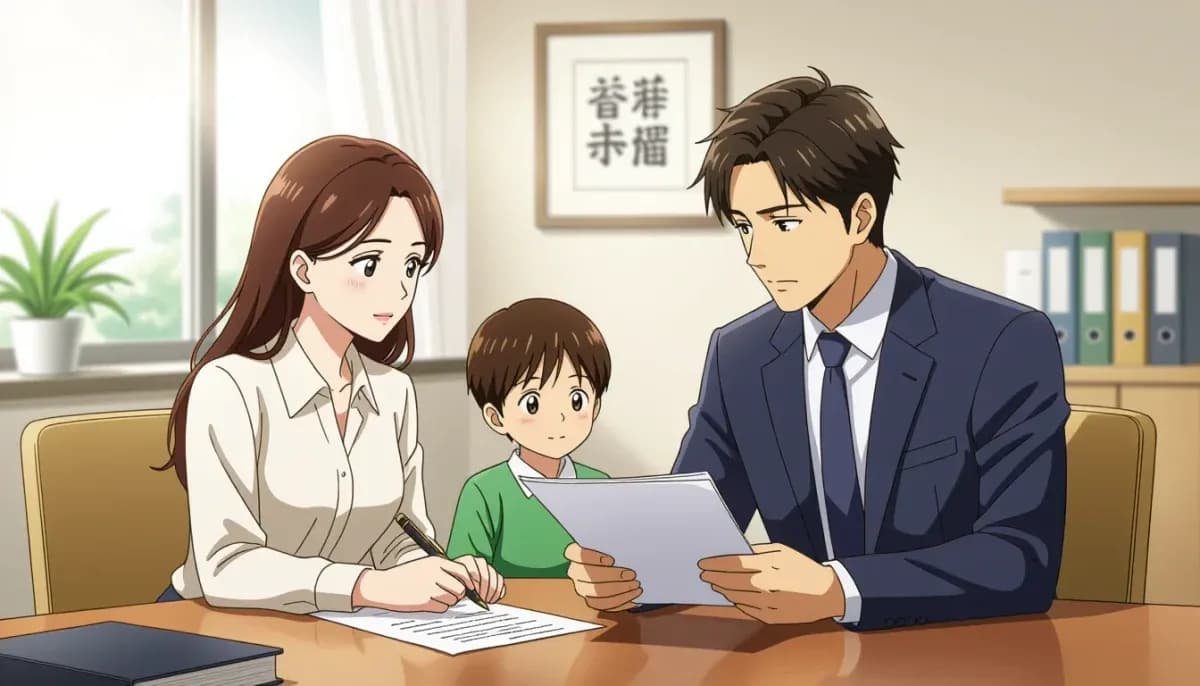
Complete guide to divorce in Japan as a foreigner: mutual consent vs. court divorce, visa implications after divorce, child custody rules, property division, and step-by-step process for expats.
Divorce in Japan as a Foreigner: Your Complete Legal Guide
Going through a divorce is emotionally draining under any circumstances. When you're a foreigner in Japan, the process comes with additional legal complexities — from navigating Japanese family court procedures and understanding your visa status, to dealing with child custody rules that differ significantly from those in many Western countries. This guide walks you through everything you need to know about divorce in Japan as a foreigner, including the three types of divorce, visa implications, child custody, asset division, and practical steps to protect yourself legally.
!Divorce legal documents in Japan with Japanese civil registry forms

The Three Types of Divorce in Japan
Japan's legal system offers three pathways for divorce, each with different requirements, timelines, and costs. Knowing which route applies to your situation is the first step.
1. Mutual Consent Divorce (Kyōgi Rikon) — The Most Common Path
About 86% of all divorces in Japan proceed through mutual consent (協議離婚, kyōgi rikon). This is the simplest and fastest method: both spouses agree to end the marriage, complete a rikon todoke (離婚届, divorce notification form), and have two witnesses sign the document before submitting it to the local city or ward office.
The process sounds straightforward, but for foreigners there are additional steps:
- You must verify that your home country will recognize a Japanese mutual consent divorce as legally valid. Some countries (especially in Europe and Latin America) do not automatically recognize kyōgi rikon.
- If both spouses are foreign nationals, consult your respective embassies before filing, as your home country may require additional court involvement.
- To protect yourself against a forged or unauthorized submission, you can file a Petition for Non-Acceptance of Notice of Divorce (rikon todoke fujuri mōshide) at the municipal office. This prevents anyone from filing a divorce without your explicit, in-person consent.
2. Mediation Divorce (Chōtei Rikon)
When spouses cannot agree on divorce terms, the next step is mediation divorce (調停離婚, chōtei rikon), which accounts for roughly 10% of divorces in Japan. One spouse files an application at the family court, and court-appointed mediators (usually one man and one woman) facilitate separate sessions with each party.
Key points for foreigners:
- Mediation is mandatory before you can proceed to litigation. Courts will not accept a divorce lawsuit unless mediation has been attempted first.
- Sessions are conducted in Japanese; if you don't speak Japanese, you are responsible for bringing your own interpreter.
- Hiring a Japanese family law attorney (bengoshi) is strongly recommended, as they can speak on your behalf and ensure your interests are protected.
- The process typically takes 3–12 months, depending on the court's workload and the complexity of disputes.
3. Litigation Divorce (Saiban Rikon)
Only 1–2% of divorces in Japan reach the litigation stage (裁判離婚, saiban rikon). A judge decides the outcome if mediation fails. To win a litigation divorce, you must prove legally recognized grounds:
| Ground for Divorce | Description |
|---|---|
| Adultery (futeikōi) | Voluntary extramarital relationship |
| Malicious abandonment (akui no iKi) | Spouse has abandoned the family without justification |
| 3-Year disappearance | Spouse has been missing for 3+ years |
| Severe mental illness | Spouse has an incurable mental illness making marriage continuation impossible |
| Other serious circumstances | Broad catch-all including domestic violence, financial ruin, or severe marital breakdown |
Litigation can take 1–3 years and is expensive. Legal fees for a contested divorce with property and custody disputes can run into the millions of yen.
Visa Implications: What Happens to Your Status After Divorce
This is one of the most critical concerns for foreigners in Japan. If your residence status depends on your marriage — most commonly a Spouse of Japanese National (日本人の配偶者等) or Spouse of Permanent Resident (永住者の配偶者等) visa — divorce has immediate legal implications.
Your Obligations After Divorce
- Report to immigration within 14 days: Under the Immigration Control Act, you must notify the nearest regional immigration bureau within 14 days of your divorce. Failure to do so can result in visa violations and may jeopardize future applications.
- Six-month grace period: Your spouse visa remains valid for six months after the divorce is finalized. During this time, you must take action — either leave Japan or apply to change your residence status.
Options for Staying in Japan After Divorce
| Option | Requirements |
|---|---|
| Work Visa (就労ビザ) | Valid job offer from a Japanese employer; degree or professional qualifications needed |
| Long-Term Resident Visa (定住者ビザ) | Lived in Japan 3–5+ years, or have Japanese children in your custody; humanitarian considerations |
| Permanent Residency (永住権) | Already have PR? Divorce does not affect your status |
| Leave Japan | Return to home country if no qualifying visa path exists |
For detailed guidance on visa options and changes, visit For Work in Japan's Family & Life Guide or the Japan Visa and Immigration Guide on this site.
For authoritative immigration procedures after divorce, the U.S. Embassy in Japan maintains a divorce resource page that all foreign nationals should consult.
Child Custody in Japan: What Foreigners Need to Know
Japan's child custody system is one of the most controversial aspects of its family law and has drawn international criticism. Understanding how it works — and what is changing — is essential for any parent going through divorce.
The Current System: Sole Custody
Under current Japanese law (pre-May 2026), only one parent receives custody after divorce. The non-custodial parent is granted visitation rights, but enforcement of those rights is extremely limited. Courts may set minimum contact requirements, but there is no strong mechanism to ensure compliance.
Statistics paint a clear picture:
- Mothers receive custody in roughly 80% of divorces involving children.
- Visitation rights are often minimal and difficult to enforce.
- Foreign parents — especially those without Japanese language skills — face additional hurdles in family court proceedings.
The 2026 Reform: Joint Custody Coming
This is major news for foreigners in Japan: Beginning in 2026, Japan's revised Civil Code will permit joint custody after divorce. This is a landmark change that brings Japan closer in line with international standards. However, courts will still have discretion, and the default may not automatically be joint custody in all cases.
For more context on family law changes and how they affect foreign residents, GaijinPot's detailed analysis provides valuable perspective.
The Hague Convention and International Child Abduction
Japan signed the Hague Convention on International Child Abduction in 2014. If your spouse takes your child to Japan — or from Japan — without your consent, you have legal remedies under this treaty. However, enforcement remains inconsistent, and the process is complex. Consulting a specialist in international family law is essential if child abduction is a concern.
!Family court mediation process in Japan

Property Division: How Assets Are Split
Japan follows a relatively straightforward framework for dividing marital assets, though the details matter enormously in practice.
The 50/50 Rule
Property acquired during the marriage is subject to division, and the general principle is a 50/50 split. However, this is not automatic — both parties must negotiate or litigate the specifics.
What is included in marital property:
- Real estate purchased during the marriage
- Savings and bank accounts accumulated during the marriage
- Investments and stocks acquired during the marriage
- Employee pensions (see below)
What is excluded from marital property:
- Property owned before the marriage
- Inherited property or gifts received by one spouse
- Debts incurred before the marriage (though debts during marriage may be shared)
Pension Division
One often-overlooked asset is the employee pension (kōsei nenkin). In Japan, you can request the division of your spouse's pension benefits accumulated during the marriage. Importantly, this request must be filed within two years of the divorce being finalized — miss this window and you lose this right entirely.
For foreigners who are themselves paying into Japan's pension system, the pension benefits you've accrued are also subject to division. Learn more about Japan's pension system in our Japan Income Tax Guide for Foreign Residents.
Prenuptial Agreements
While prenuptial agreements (kekkon mae keiyaku) are technically legal in Japan, they are rarely enforced by courts. Japanese family courts have wide discretion to disregard provisions they deem unfair or against public policy. Do not rely on a prenup as your primary protection — it is not the same safety net it might be in other jurisdictions.
Finding a Lawyer: Your Most Important Decision
Navigating Japanese family law without professional help is extremely difficult, even if you speak Japanese. For foreigners, having qualified legal representation is nearly essential.
Types of Legal Professionals
| Professional | Japanese Title | Role |
|---|---|---|
| Attorney (bengoshi) | 弁護士 | Full legal representation; can appear in court; handle all aspects of divorce |
| Judicial Scrivener (shiho shoshi) | 司法書士 | Can assist with paperwork; limited to non-contested cases |
| Administrative Scrivener (gyosei shoshi) | 行政書士 | Can assist with immigration-related paperwork post-divorce |
Where to Find English-Speaking Family Lawyers
- Japan Federation of Bar Associations (日本弁護士連合会) — has a directory with lawyer search options
- Your home country's embassy or consulate — often maintains referral lists of lawyers experienced with international family law
- Legal aid (horitsu fujo) — available for low-income residents through the Japan Legal Support Center (法テラス)
- Specialist international divorce firms — firms in Tokyo, Osaka, and other major cities specifically handle international cases
The Living in Nihon Legal Troubleshooting Guide has additional resources for finding legal help in Japan.
For comprehensive information about legal procedures in Japan, Japan Dev's detailed divorce guide is an excellent English-language resource.
Step-by-Step: The Divorce Process for Foreigners
Here's a practical roadmap for foreigners going through divorce in Japan:
Step 1: Gather Your Documents
- Marriage certificate (kon'in todoke) — certified copy from the city/ward office where you registered
- Your residence card (zairyu card)
- Passports for both spouses
- Birth certificates of any children
- Financial documents: bank statements, property ownership documents, pension records
Step 2: Choose Your Divorce Path
Assess whether mutual consent is possible. If not, consult a lawyer immediately about mediation or litigation.
Step 3: Notify Your Embassy
Contact your home country's embassy or consulate to understand how a Japanese divorce will be recognized in your home country and what additional steps (if any) are required.
Step 4: Complete the Rikon Todoke (for mutual consent divorce)
Download the form from your city or ward office, complete it with two witnesses, and submit it. The divorce is effective immediately upon acceptance.
Step 5: Notify Immigration Within 14 Days
Visit your nearest regional immigration bureau or submit notification online through the Immigration Services Agency portal. Bring your residence card and divorce certificate.
Step 6: Plan Your Visa Transition
Work with an immigration lawyer or administrative scrivener to identify your best visa pathway. Do not wait until the 6-month deadline is imminent.
Step 7: Register the Divorce in Your Home Country
Many countries require additional steps to formally recognize your Japanese divorce. Contact your embassy for the specific process — this often involves submitting a certified translation of the Japanese divorce certificate.
For more help with life admin in Japan, check out our guides on opening a bank account in Japan and Japan's national health insurance system to make sure your key services remain active after a change in status.
Special Considerations: Domestic Violence and Safety
If you are divorcing due to domestic violence, Japan has legal protections available to you regardless of your visa status.
- Protection Orders (hogo meirei): Courts can issue protection orders preventing your spouse from approaching you, your home, or your workplace.
- DV Shelters: The government operates shelters (配偶者暴力相談支援センター) for victims of domestic violence. You can access these regardless of nationality or visa status.
- Reporting: File a police report if you have experienced physical violence. This documentation strengthens your case both in divorce proceedings and any visa change applications.
Your residency status does not have to prevent you from leaving an abusive situation. Contact the Japan DV support hotline or your nearest ward office for immediate assistance.
Key Takeaways: Divorce in Japan for Foreigners
Divorce in Japan as a foreigner is manageable, but it requires careful planning, legal guidance, and prompt action — especially regarding your visa status. Here's a summary of what to remember:
- 86% of Japanese divorces are mutual consent (kyōgi rikon) — the simplest route if both parties agree
- Foreigners must notify immigration within 14 days and have 6 months to arrange their visa after divorce
- Joint custody becomes legal in 2026 — a major change from the current sole-custody system
- Property acquired during marriage is split 50/50; pension division requests must be filed within 2 years
- Always consult an English-speaking family law attorney early in the process
- Your home country may not automatically recognize a Japanese mutual consent divorce — check with your embassy
Getting through a divorce while navigating a foreign legal system takes resilience. But with the right professional support and a clear understanding of the process, you can protect your rights and plan your next chapter — whether that's continuing your life in Japan or returning home.
For additional resources on legal topics for foreigners in Japan, visit the Living in Nihon Legal Issues Guide, the Small Business Japan resource on post-divorce visa support, and Ittenshoku's IT career and Japan life resources for further support during your transition.

Originally from Vietnam, living in Japan for 16+ years. Graduated from Nagoya University, with 11 years of professional experience at Japanese and international companies. Sharing information about living in Japan for foreigners.
View Profile →Related Articles
Managing Long Distance Relationships When Moving to Japan
Moving to Japan doesn't have to end your relationship. Learn how to manage a long-distance relationship after relocating to Japan: communication tools, time zone tips, visit planning, and visa pathways to close the gap.
Read more →
LGBTQ Life and Rights in Japan for Foreigners
A comprehensive guide to LGBTQ life and rights in Japan for foreigners. Covers legal status, partnership certificates, community life in Shinjuku Ni-chome, workplace rights, visa challenges, and practical tips for LGBTQ expats living in Japan.
Read more →
Cultural Differences in Japanese Romantic Relationships
Discover the key cultural differences in Japanese romantic relationships: kokuhaku confessions, amae dependence, gift-giving customs, gender roles, PDA norms, and family expectations — a complete guide for foreigners dating in Japan.
Read more →
Marriage Registration Documents Required in Japan
Complete guide to marriage registration documents required in Japan for foreigners. Learn what documents you need, how to get the Certificate of No Impediment, and the step-by-step registration process at city hall.
Read more →
Common Law and Domestic Partnership in Japan Explained
Learn everything about common law partnerships (jijitsu-kon) and domestic partnership certificates in Japan. Understand visa implications, legal rights, inheritance, and what foreigners need to know.
Read more →
Wedding Ceremony Options in Japan for Foreign Couples
Discover all wedding ceremony options in Japan for foreign couples: Shinto shrine rituals, chapel ceremonies, and civil weddings. Compare costs, legal requirements, and tips for planning your Japan wedding.
Read more →