
How to Take Your Pet Out of Japan Export Guide

Complete guide to exporting your dog or cat from Japan. Learn the step-by-step process, required documents, AQS inspection requirements, destination country rules, and costs for taking your pet out of Japan.
How to Take Your Pet Out of Japan: Complete Export Guide
Leaving Japan with your beloved dog or cat? The process of exporting pets from Japan requires careful planning, official documentation, and coordination with Japan's Animal Quarantine Service (AQS). Whether you're an expat heading home after years abroad or relocating to a new country, this guide walks you through every step of taking your pet out of Japan safely and legally.
The good news: Japan's pet export process, while thorough, is straightforward once you understand the requirements. The key is starting early — ideally 7 or more months before your departure date — to allow sufficient time for vaccinations, health checks, and paperwork.
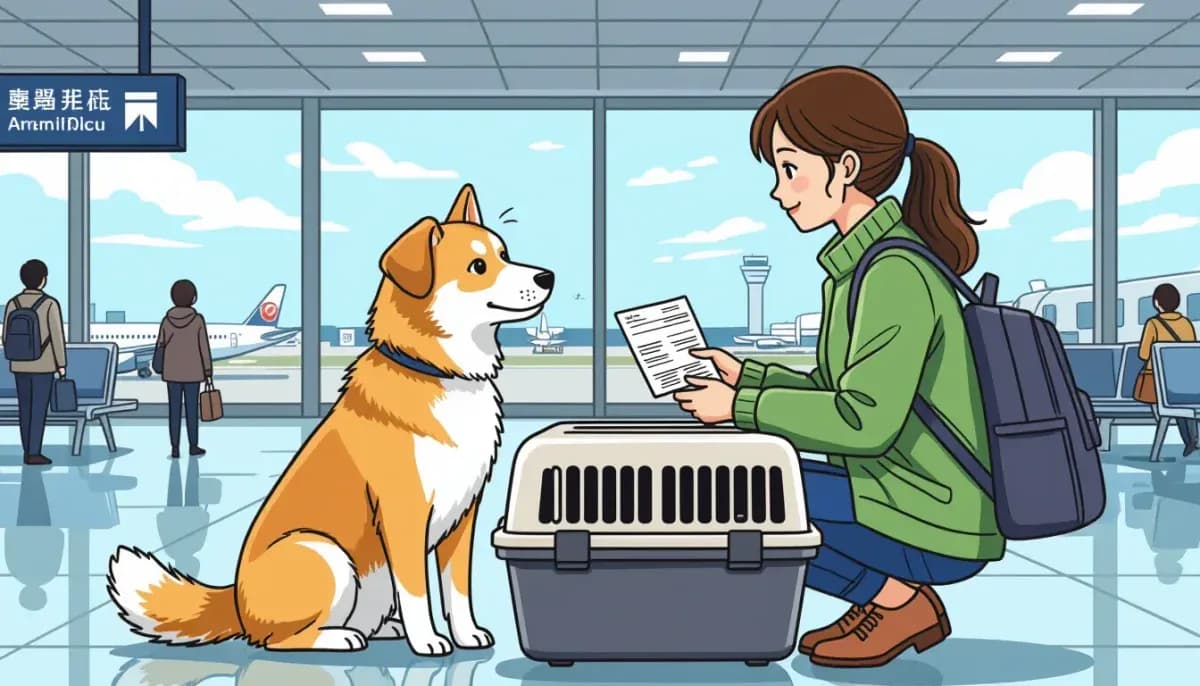
!Person with dog at Japanese airport preparing for international pet travel

Understanding Japan's Pet Export Framework
Japan's Animal Quarantine Service (AQS), operated under the Ministry of Agriculture, Forestry and Fisheries (MAFF), oversees all pet imports and exports. When you take your pet out of Japan, you must satisfy two sets of requirements:
- Japan's exit conditions — What Japan requires before allowing your pet to leave
- Destination country's entry conditions — What your destination country requires for your pet to enter
Both must be fulfilled simultaneously, which is why early research and planning are essential. The requirements can vary significantly depending on where you're going — moving to the UK or Australia (both rabies-free countries) involves stricter protocols than moving to many other destinations.
Before beginning the process, visit the official AQS export page for dogs and cats and contact your destination country's embassy or veterinary authority in Japan for their specific import requirements.
For additional guidance on pet life in Japan, check out our Complete Guide to Pet Ownership in Japan and our overview of how to bring a pet to Japan if you're considering a return trip.
Step-by-Step: The Japan Pet Export Process
Step 1: Research Your Destination Country's Requirements
The first step — before anything else — is to understand what your destination country requires. Some countries have highly specific rules:
- Rabies-free countries (UK, Ireland, Australia, New Zealand, Singapore, etc.) require a rabies antibody titer test and may impose waiting periods
- Other developed nations (USA, Canada, most of Europe) typically require current vaccinations, health certificates, and microchipping
- Some countries require an import permit obtained in advance
Contact the destination country's embassy in Japan or their official veterinary/agricultural authority to get the most up-to-date requirements. Requirements can change, and relying on outdated information is one of the most common mistakes pet owners make.
Step 2: Ensure Your Pet Has ISO-Compliant Microchipping
Japan requires that all exported dogs and cats have an ISO-compliant microchip. Specifically, the microchip must conform to ISO 11784 and ISO 11785 standards — a 15-digit numeric code. This is the international standard used in most countries.
If your pet was microchipped in Japan (as required for Japan's pet registration system), it's likely already ISO-compliant. However, if your pet was microchipped in another country using a non-ISO format (common with older US chips), you may need a secondary chip implanted.
Before your export inspection, verify that the microchip scanner at the quarantine station can read your pet's chip. The AQS advises owners to confirm microchip readability in advance.
Step 3: Complete Vaccination and Health Requirements
Depending on your destination, you'll need to arrange various veterinary procedures. Common requirements include:
- Rabies vaccination — Most countries require a current rabies vaccination (valid vaccination history)
- Rabies antibody titer test — Required for many countries, especially those that are rabies-free. The blood sample must show an antibody level of 0.5 IU/ml or higher
- Other vaccinations — Distemper, parvovirus, and other core vaccines may be required
- Health certificate — A veterinary health certificate issued close to departure (often within 10 days)
- Parasite treatment — Some countries require treatment for heartworm, tapeworm, or ticks
Work with a veterinarian who has experience in international pet transport. They can help you sequence the procedures correctly and ensure certificates are formatted to meet destination country standards. Professional pet relocation services like PetAir JPN specialize in this process and can provide country-specific guidance.
Step 4: Apply for Export Inspection (At Least 10 Days in Advance)
You must apply for export inspection at the Animal Quarantine Service at least 10 days before your desired inspection date. Applications should be submitted with all required certificates and documents attached.
How to apply:
- Download the application form from the AQS website (separate forms exist for dogs and cats, available in PDF or Excel format)
- Attach all original certificates/attestations proving compliance with destination entry conditions
- Submit via email (maximum 14MB per message) or in person at the AQS office at your departure airport
- If someone other than the registered owner will bring the animal to inspection, include a Power of Attorney document
AQS offices are located at major international airports including Narita, Haneda, Kansai (Osaka), and Chubu (Nagoya). Inspection hours are 8:30–16:30 daily.
Step 5: Undergo Export Inspection
The export inspection is conducted within 10 days before your departure date. During the inspection:
- An Animal Quarantine Officer will examine your pet and verify all documentation
- The process typically takes 30–60 minutes (longer for multiple pets or complex destination requirements)
- The officer will verify microchip readability
- If everything is in order, you'll receive an Export Quarantine Certificate in English
This certificate is your official documentation that your pet has been inspected and cleared for export from Japan. Keep it safe — you'll need it when arriving at your destination.
Important warning: Counterfeit or falsified documents will result in immediate inspection denial and export prohibition. Always use legitimate veterinary documentation.
!Pet travel documentation and health certificates for international travel

Japan Pet Export Requirements at a Glance
| Requirement | Details | Who Needs It |
|---|---|---|
| ISO Microchip | ISO 11784/11785, 15-digit code | All pets |
| Rabies Vaccination | Current, valid vaccination | Most destinations |
| Rabies Titer Test | ≥0.5 IU/ml antibody level | Rabies-free countries |
| Health Certificate | Issued by licensed vet, often within 10 days | All pets |
| Export Application | Submit 10+ days before inspection | All pets |
| Export Inspection | Within 10 days before departure | All pets |
| Export Quarantine Certificate | Issued after successful inspection | All pets |
| Import Permit | Some destination countries require advance permit | Varies by country |
| Parasite Treatment | Tapeworm, tick treatment | Selected countries |
Destination-Specific Considerations
Moving to the United States or Canada
The US and Canada have relatively straightforward requirements for dogs and cats coming from Japan. Requirements typically include:
- A current rabies vaccination for dogs (cats have fewer federal requirements, though airlines may require it)
- A health certificate issued by a licensed veterinarian
- Dogs must appear healthy at the US port of entry
The US Centers for Disease Control (CDC) has specific rules about dogs from countries with dog rabies. Japan is generally considered low-risk, but requirements do change, so verify with the USDA APHIS before traveling.
Moving to the UK, Ireland, Australia, or New Zealand
These rabies-free countries have the most stringent requirements:
- Approved microchip in place before first rabies vaccination
- At least two rabies vaccinations administered correctly
- Rabies antibody titer test showing ≥0.5 IU/ml, taken after the vaccination series
- Waiting period of at least 180 days after the titer test before entry (for some countries)
- Tapeworm treatment administered 1–5 days before arrival (UK requirement for dogs)
Start planning at least 7 months before departure if heading to these countries. The timeline cannot be accelerated.
Moving to Singapore or Hong Kong
Singapore and Hong Kong accept pets from Japan with moderate requirements:
- Current rabies vaccination
- Health certificate from a government-accredited veterinarian
- Advance import license/permit (apply through the country's veterinary authority)
- Some pets may require a brief quarantine period at the destination
Costs: What to Budget for Pet Export
The cost of exporting your pet from Japan varies based on your destination and whether you use professional relocation services.
| Expense Category | Estimated Cost (JPY) |
|---|---|
| AQS Export Inspection Fee | ~¥2,000–¥5,000 |
| Rabies Titer Test | ¥15,000–¥30,000 |
| Health Certificate (Vet) | ¥10,000–¥30,000 |
| Professional Pet Relocation Service | ¥150,000–¥500,000+ |
| Airline Pet Cargo/Cabin Fee | ¥20,000–¥100,000+ |
| Quarantine at Destination (if required) | Varies widely |
| Microchipping (if needed) | ¥5,000–¥15,000 |
For context, importing pets into Japan costs approximately ¥250,000–¥500,000 from the US and ¥400,000–¥800,000 from Europe according to expat resources. Exporting from Japan is generally less expensive, but costs can add up quickly, especially for destinations with strict quarantine requirements.
During any required quarantine at the destination, detention fees (such as those at Narita if your pet must stay) can run approximately ¥3,000+ per day including basic boarding and care.
Practical Tips for a Smooth Pet Export
Start Planning Early The single most important advice: begin the process as soon as you know you're leaving Japan. For destinations like the UK or Australia, you need 7+ months. Even for simpler destinations, starting 3–4 months ahead gives you buffer time for any complications.
Work with a Specialist Vet Not all veterinarians in Japan are familiar with international export requirements. Find a vet experienced in pet relocations — they'll know which vaccines need to be documented in which format, how to prepare certificates that meet destination standards, and what common mistakes to avoid.
Use Professional Pet Relocation Services For complex moves (especially to strict countries), professional pet relocation companies are worth the cost. Services like PetAir JPN coordinate the entire process, from veterinary procedures to airline arrangements to destination clearance. You can also find resources through Living in Nihon for expat life guidance.
Plan Your Airline Arrangements Early Most airlines have limited space for pets (especially in-cabin), and pet cargo spots book up fast during peak travel seasons. Contact your airline as soon as your travel dates are confirmed. Each airline has its own pet transport policies, carrier size requirements, and breed restrictions (many airlines restrict brachycephalic breeds like pugs and bulldogs).
Keep Copies of Everything Make copies of all certificates, vaccination records, and the export quarantine certificate. Keep digital copies in the cloud. If any document is lost or damaged, having a backup can save your trip.
Check Breed Restrictions Some countries (including the UK and Canada) have breed-specific legislation that may affect certain dog breeds. Even if Japan allows the breed, your destination country might not. Research this early.
For more practical guidance on expat life in Japan, explore resources at For Work in Japan and Ittenshoku for additional relocation support.
What Happens If You Don't Follow the Process?
Skipping or shortcutting the export process can have serious consequences:
- Denial of boarding — Airlines are required to check pet documentation, and your pet may be refused if paperwork is incomplete
- Quarantine at destination — Your pet may be held in quarantine at the destination country, potentially for months, at significant expense
- Return to Japan — In worst-case scenarios, your pet may be sent back to Japan
- Fines and legal issues — Falsifying documents is a criminal offense
The official process exists to protect animal health globally, preventing the spread of diseases like rabies. Following it fully is the only right approach.
Finding Support and Resources
You don't have to navigate this process alone. Here are key resources:
- Japan Animal Quarantine Service (AQS): maff.go.jp/aqs/english — Official export guidance
- Your destination country's embassy in Japan — For import requirements
- Professional pet relocation companies — PetAir JPN and others offer full-service coordination
- Expat communities — Online forums and groups of foreigners in Japan often share first-hand experiences
Also check out our related guides:
- Pet Registration and Microchip Requirements in Japan
- Pet Insurance Options in Japan
- Traveling with Pets in Japan
- Pet Friendly Housing in Japan
Taking your pet out of Japan requires paperwork and planning, but with the right preparation, you and your furry family member can make the move smoothly. Start early, work with qualified professionals, and always verify requirements directly with official sources before making any decisions.

Originally from Vietnam, living in Japan for 16+ years. Graduated from Nagoya University, with 11 years of professional experience at Japanese and international companies. Sharing information about living in Japan for foreigners.
View Profile →Related Articles

Pet Friendly Parks and Facilities in Japan
Complete guide to pet-friendly parks, dog runs, and facilities in Japan for foreigners. Learn about Yoyogi Park dog run, pet etiquette, rules, and the best neighborhoods for pet owners in Tokyo and beyond.
Read more →
Exotic Pet Ownership Rules in Japan
Complete guide to exotic pet ownership rules in Japan for foreigners. Learn which animals are banned, which require permits, CITES regulations, import process, and safety tips.
Read more →
Pet Sitting and Boarding Services in Japan
Complete guide to pet sitting and boarding in Japan for foreigners and expats. Covers top platforms like HappyWanNyan and Pet Backer, pricing, tips, and English-friendly facilities.
Read more →
Cat Ownership in Japan Complete Guide
Everything foreigners need to know about owning a cat in Japan — pet-friendly apartments, microchipping laws, vet costs, adoption, and daily life tips for expat cat owners.
Read more →
Traveling with Pets in Japan Transportation Guide
A complete guide to traveling with pets in Japan. Learn the rules for trains, shinkansen, buses, flights, pet taxis and car rentals. Essential tips for foreigners with dogs and cats.
Read more →
Pet Stores and Animal Adoption Centers in Japan
Complete guide to finding a pet in Japan as a foreigner. Compare pet stores vs adoption centers, discover foreigner-friendly shelters like ARK and Buddies, and learn about costs and the adoption process.
Read more →